
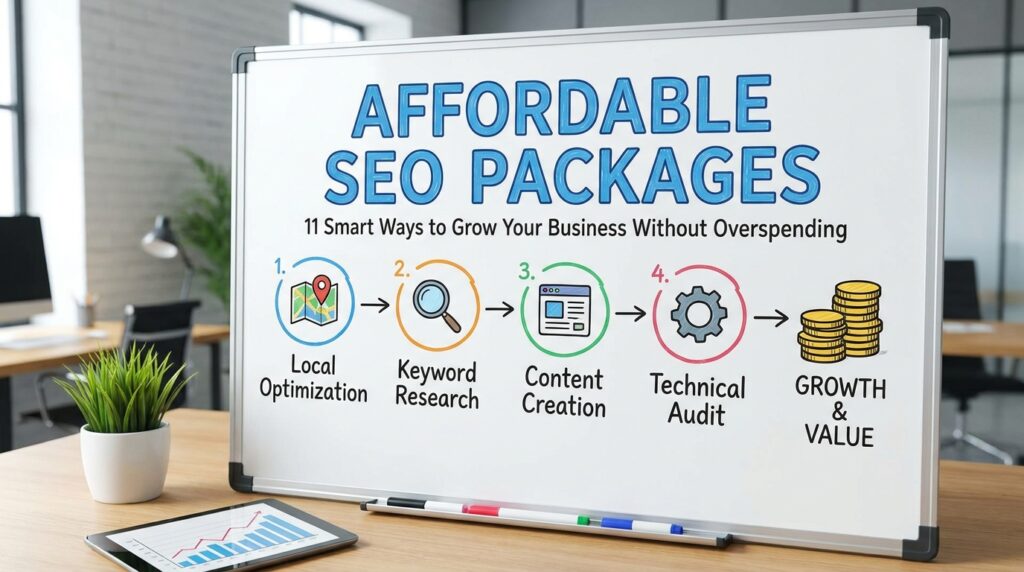
Finding affordable SEO packages can feel like searching for a needle in a haystack. Some providers promise hundreds of backlinks for a surprisingly low price, while others charge thousands of dollars before explaining what you actually receive. The good news is that effective search engine optimization does not always require a massive budget. The right affordable SEO packages can give small businesses, startups, local companies, bloggers, and growing brands access to strategic SEO services without sacrificing quality.
The key is understanding what you are paying for, which services genuinely influence organic visibility, and how to distinguish sustainable SEO from shortcuts that can damage your website. In this guide, you will learn what affordable SEO should include, how much SEO services typically cost, what to look for in a package, which warning signs to avoid, and how to choose an SEO plan that produces measurable long-term value.
What Are Affordable SEO Packages?
Affordable SEO packages are structured search engine optimization service plans designed to provide essential SEO work at a manageable monthly or project-based price.
Rather than paying separately for every task, a business typically receives a combination of services such as keyword research, on-page optimization, technical SEO, content recommendations, local SEO, competitor analysis, reporting, and link-building support.
The word “affordable” does not necessarily mean “cheap.” Quality SEO requires research, expertise, content development, technical analysis, and continuous measurement. A package that costs less because it focuses on the highest-impact activities can be considerably more valuable than a cheap plan filled with automated or low-quality services.
For example, a local plumbing company may not need an enormous national link-building campaign. It may benefit more from Google Business Profile optimization, service-page improvements, local keyword research, location content, review strategy, and technical cleanup.
That is where well-designed affordable SEO packages can make sense.
Why Affordable SEO Packages Matter for Small Businesses
Small businesses often face a difficult marketing equation: they need visibility, but they cannot always compete with the advertising budgets of national brands.
Organic search can provide an alternative because SEO allows businesses to build visibility around relevant searches over time.
Consider a hypothetical landscaping company targeting customers in Dallas. Instead of trying to rank immediately for an extremely competitive phrase such as “landscaping services,” the company could target more specific searches such as “residential landscaping company in Dallas,” “lawn maintenance services in North Dallas,” and individual service-related queries.
A focused SEO strategy can help the business build topical relevance while targeting searches with stronger commercial intent.
The best affordable SEO packages therefore prioritize strategy over volume. They identify where a business has realistic opportunities and allocate resources accordingly.
What Should Affordable SEO Packages Include?
Not every SEO package is structured the same way. However, a professional plan should address the major components that influence organic search performance.
Keyword Research and Search Intent
Keyword research is the foundation of an effective SEO campaign.
A professional SEO provider should identify keywords based on search volume, competition, relevance, business value, and search intent. The goal is not simply to find keywords with the highest number of searches.
For example, “running shoes” may have enormous search volume, but “best running shoes for flat feet” communicates much more specific intent.
Affordable SEO packages should connect keywords to pages and user needs rather than stuffing keywords into existing content.
Search intent is generally divided into informational, navigational, commercial, and transactional searches. Understanding these categories helps determine what type of content each keyword deserves.
On-Page SEO
On-page optimization involves improving the content and structure of individual web pages.
This can include optimizing title tags, meta descriptions, headings, URLs, internal links, image attributes, content structure, and keyword relevance.
However, modern on-page SEO goes beyond inserting a phrase a certain number of times.
Search engines increasingly evaluate whether a page provides useful information and satisfies the user’s underlying need. A well-optimized page should be easy to understand, logically structured, trustworthy, and genuinely useful.
Technical SEO
Technical SEO ensures that search engines can efficiently crawl, understand, and index a website.
Depending on the site, technical work may include improving page speed, resolving crawl errors, managing redirects, fixing broken links, improving mobile usability, addressing duplicate content, reviewing canonical tags, and examining structured data.
Technical SEO can be particularly valuable for businesses whose websites have accumulated problems over several years.
A website with excellent content can still struggle if important pages cannot be properly crawled or indexed.
Content Strategy
Content remains a major component of SEO because websites need useful information that answers relevant searches.
Effective affordable SEO packages may include content briefs, blog strategy, service-page recommendations, content optimization, or a limited number of professionally written articles.
The important distinction is quality.
Publishing 50 thin articles is not necessarily better than publishing 10 comprehensive resources that genuinely answer important customer questions.
A strong content strategy should identify topic clusters, informational gaps, commercial opportunities, and internal linking relationships.
Local SEO
For businesses serving specific geographic areas, local SEO can be one of the highest-value components of an affordable campaign.
Local SEO may involve optimizing a Google Business Profile, improving local landing pages, managing business information consistency, developing locally relevant content, and supporting legitimate review-generation strategies.
A dentist, restaurant, roofing company, law firm, or home-service provider can benefit significantly from appearing prominently for location-based searches.
Link Building and Digital PR
Backlinks can contribute to a website’s authority, but link quality matters more than raw quantity.
Professional SEO providers should focus on earning relevant, legitimate links rather than using automated networks or spammy directories.
A credible campaign may use digital PR, expert contributions, useful resources, partnerships, industry publications, original research, or link-worthy content.
When evaluating affordable SEO packages, ask how backlinks are acquired. If a provider guarantees thousands of links every month, that should immediately raise questions about quality and sustainability.
How Much Do Affordable SEO Packages Cost?
The price of SEO varies considerably depending on the provider, website size, industry competition, geographic targeting, and scope of work.
Entry-level affordable SEO packages for small businesses may cost a few hundred dollars per month, while more comprehensive campaigns can cost considerably more.
The important issue is not finding the lowest monthly price. It is determining whether the package provides enough meaningful work to create progress.
For example, a $199 monthly package might appear attractive, but if the provider only sends an automated report and makes minimal website changes, the actual value could be poor.
Conversely, a $600 monthly package that includes technical auditing, content optimization, local SEO, keyword research, strategic recommendations, and transparent reporting could produce significantly more value.
SEO should therefore be evaluated as an investment rather than simply an expense.
11 Features to Look for in Affordable SEO Packages
1. A Customized SEO Strategy
Avoid providers that give every customer exactly the same checklist.
Your website, competitors, industry, location, audience, and business objectives are unique. A good SEO campaign should reflect those differences.
2. Transparent Deliverables
You should know what the provider will actually do.
A professional proposal should explain the services included, expected frequency, reporting process, and responsibilities of both parties.
Transparency is one of the strongest indicators of trustworthy affordable SEO packages.
3. Realistic Goals
Be cautious of anyone guaranteeing a number-one Google ranking within a specific timeframe.
Search rankings depend on numerous factors, including competition, website quality, content relevance, technical health, authority, and search-engine changes.
A responsible provider should discuss measurable goals such as organic traffic growth, improved rankings for relevant terms, conversions, qualified leads, and visibility.
4. Quality Content
Your SEO provider should understand content quality rather than simply producing keyword-heavy articles.
Strong content demonstrates expertise, answers real questions, provides evidence where appropriate, and gives users a reason to trust the business.
5. Technical Auditing
Even a relatively inexpensive SEO campaign should identify major technical problems.
A technical audit can uncover indexing problems, broken links, slow pages, duplicate URLs, missing metadata, and other issues that may prevent content from performing effectively.
6. Competitor Research
Your competitors provide useful information about the search landscape.
SEO analysis can reveal which topics competitors cover, which pages attract links, what keywords they target, how their content is structured, and where gaps exist.
The objective is not to copy competitors. It is to understand the market and find opportunities to create something better.
7. Meaningful Reporting
A monthly SEO report should explain what happened and why.
Useful reports may include organic traffic trends, keyword visibility, landing-page performance, conversions, technical improvements, content published, links earned, and recommendations for the next period.
A report full of complicated metrics but no business context is not particularly useful.
8. Human Oversight
Automation can make SEO more efficient, but strategy should not be completely automated.
Experienced professionals should review recommendations, content, technical changes, and campaign performance.
This human oversight is especially important when AI tools are involved in research or content production.
9. Ethical SEO Practices
Your provider should follow sustainable SEO principles.
Avoid providers that recommend hidden text, keyword stuffing, deceptive redirects, manipulative link schemes, automatically generated spam pages, or other tactics designed primarily to manipulate search rankings.
10. Conversion Tracking
Traffic alone does not necessarily equal business success.
A successful SEO campaign should eventually connect organic visibility to outcomes such as purchases, form submissions, calls, appointments, downloads, or qualified leads.
11. Scalability
The best affordable SEO packages should give your business room to grow.
You might begin with keyword research, technical improvements, and on-page optimization. Later, you can expand into content marketing, digital PR, link acquisition, local SEO, or national campaigns as your results and budget grow.
Cheap SEO vs. Affordable SEO: What Is the Difference?
There is an important distinction between cheap SEO and affordable SEO.
Cheap SEO focuses primarily on minimizing the provider’s cost.
Affordable SEO focuses on maximizing the customer’s return within a realistic budget.
Imagine two providers.
Provider A promises 2,000 backlinks, 100 keywords, and automated monthly reports for $150.
Provider B charges $500 but performs a technical audit, optimizes important commercial pages, researches realistic keywords, improves internal linking, publishes strategic content, and provides transparent reporting.
Provider A is cheaper.
Provider B may be more affordable.
The difference is value per dollar, not the monthly invoice alone.
A Mini Case Study: How a Local Business Could Use Affordable SEO
Imagine a small HVAC company operating in Phoenix.
The company has a five-page website but receives very little organic traffic. It currently targets broad terms such as “HVAC company” without dedicated pages for its major services.
An SEO campaign could begin with keyword research and a technical audit.
The provider might discover opportunities around searches related to AC repair, emergency HVAC service, heat-pump installation, seasonal maintenance, and location-specific services.
Instead of publishing dozens of generic blog posts, the campaign could improve the company’s core service pages, create useful supporting resources, strengthen internal links, optimize local search signals, and improve conversion elements.
Over time, the business could develop stronger topical coverage and attract more qualified search traffic.
This example illustrates why affordable SEO packages should be built around business priorities rather than arbitrary task counts.
What Research Says About SEO and Search Visibility
SEO decisions should be grounded in evidence rather than assumptions.
Academic research into information retrieval has long examined how search engines evaluate relevance, authority, document quality, and user needs. Modern search systems are substantially more sophisticated than the keyword-matching systems of the early web.
Google’s own public documentation also emphasizes creating helpful, reliable, people-first content rather than content designed exclusively to manipulate search rankings.
Google’s Search Advocate John Mueller has repeatedly emphasized the importance of creating useful websites for users rather than focusing solely on search-engine manipulation.
One practical takeaway is especially important:
“Focus on creating a great website for your users.”
This principle aligns with a broader SEO lesson: optimization should support a genuinely useful website, not attempt to disguise a weak one.
How to Choose the Right Affordable SEO Package
Start by identifying your primary business objective.
Do you want more local customers? More ecommerce sales? More B2B leads? More organic traffic? Better visibility for a new website?
Your objective determines the appropriate SEO strategy.
Next, evaluate your current website.
A small local business with technical problems needs a different package from an established ecommerce website with thousands of product pages.
Then examine the provider’s methodology.
Ask questions such as:
What exactly is included each month?
Who performs the work?
How are keywords selected?
How are backlinks acquired?
What reporting will I receive?
How will conversions be measured?
What happens if the strategy needs to change?
The answers can reveal whether a provider is selling a genuine service or simply a standardized package.
Common Mistakes When Buying Affordable SEO Packages
One of the biggest mistakes is choosing solely based on price.
Another is expecting immediate results.
SEO can take time because search engines need to crawl, process, evaluate, and re-evaluate changes. Competitive industries can require significantly more effort than less competitive niches.
Another mistake is focusing entirely on keyword rankings.
Rankings are useful, but they are not the final objective. A keyword ranking in position three is valuable only if it attracts relevant users who can become customers.
Businesses should also avoid providers that refuse to explain their work.
You do not need to understand every technical detail, but you deserve enough transparency to know where your money is going.
Affordable SEO Packages for Different Business Types
Startups
Startups can benefit from foundational SEO, keyword research, technical setup, content architecture, and strategic landing pages.
Local Businesses
Local companies should prioritize local search optimization, service pages, reviews, geographic relevance, and conversion-focused content.
Ecommerce Stores
Ecommerce businesses often need product-page optimization, category-page strategy, technical SEO, internal linking, structured data, and content marketing.
B2B Companies
B2B organizations can benefit from long-form educational content, comparison pages, solution pages, case studies, industry research, and lead-focused SEO.
Bloggers and Publishers
Publishers may focus on topical authority, content quality, internal linking, search intent, information architecture, and content refreshes.
This flexibility is another reason affordable SEO packages should not be treated as one-size-fits-all products.
How to Measure SEO ROI
A successful SEO campaign should eventually demonstrate business value.
Important metrics include organic sessions, engaged users, keyword visibility, landing-page performance, conversion rate, leads, revenue, and customer acquisition cost.
For example, suppose a company spends $600 per month on SEO.
If the campaign eventually generates 20 qualified leads per month and several become customers, the business can compare those results with the cost of paid advertising or other marketing channels.
SEO measurement should also account for the fact that organic assets can continue generating traffic after the initial work has been completed.
That long-term potential is one of SEO’s strongest advantages.
Are Affordable SEO Packages Worth It?
Yes—when they are strategically designed and professionally executed.
The best affordable SEO packages concentrate limited resources on activities with realistic potential to improve visibility and business outcomes.
They do not promise magic.
They do not rely on massive quantities of low-quality links.
They do not measure success exclusively through vanity metrics.
Instead, they build a stronger website through technical improvements, useful content, search-intent alignment, relevant authority, and continuous measurement.
The right package should also evolve as your website grows.
Frequently Asked Questions
Are affordable SEO packages effective?
Yes. Affordable SEO packages can be effective when they prioritize high-impact activities such as technical SEO, keyword research, on-page optimization, content strategy, local SEO, and performance measurement.
A smaller budget may limit the amount of work that can be completed each month, but it does not automatically prevent meaningful results.
How much should a small business spend on SEO?
There is no universal price because SEO requirements vary by industry, location, competition, website size, and goals.
Small businesses should focus on obtaining measurable value rather than selecting the lowest-priced provider. A sustainable monthly investment is generally more useful than an inexpensive package that delivers little actual work.
Can SEO work with a small budget?
Absolutely. A small budget can support focused SEO activities.
For example, a company might begin by fixing technical problems, optimizing its most important commercial pages, targeting long-tail keywords, improving internal links, and publishing high-quality content consistently.
How long does affordable SEO take to produce results?
SEO results can vary significantly. Some technical and on-page improvements may produce relatively quick changes, while competitive keyword growth and authority development can take considerably longer.
A realistic campaign should evaluate progress over multiple months rather than expecting instant rankings.
Should I choose monthly or one-time SEO services?
It depends on your needs.
A one-time SEO audit can be useful for businesses that need a strategic diagnosis. Monthly SEO is more appropriate when the website requires ongoing content, technical improvements, monitoring, optimization, and competitive analysis.
How can I avoid bad SEO providers?
Ask for specific deliverables, reporting examples, explanations of link-building methods, realistic expectations, and evidence of previous work.
Be particularly cautious about guaranteed rankings, enormous backlink promises, vague deliverables, and providers who refuse to explain their methods.
Final Thoughts on Affordable SEO Packages
Choosing affordable SEO packages should never mean choosing the cheapest SEO service available. The better goal is finding a package that delivers strategic value, transparent work, sustainable optimization, and measurable business results within your budget.
The strongest approach combines technical SEO, keyword research, useful content, on-page optimization, local or industry-specific strategies, ethical authority building, and meaningful reporting.
Whether you are running a startup, local business, ecommerce store, professional service company, or growing online brand, SEO can become a long-term acquisition channel when it is approached strategically.
Before signing a contract, examine the deliverables, understand the strategy, ask how success will be measured, and make sure the provider’s methods align with sustainable SEO principles.
The right affordable SEO packages do not simply make SEO cheaper—they make your SEO investment smarter.


Pingback: Organic SEO Services: 11 Proven Strategies to Grow Sustainable Google Traffic