
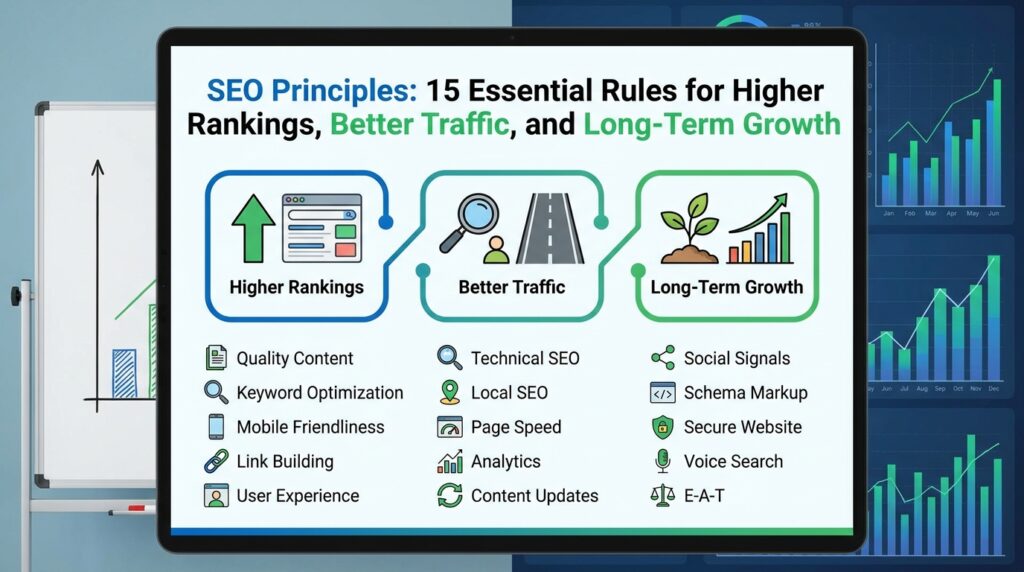
Search visibility can make or break an online business, but ranking well on Google is not about stuffing pages with keywords or chasing every algorithm update. The most sustainable approach is to understand and apply proven seo principles that help search engines discover, understand, evaluate, and recommend useful content. Whether you run a small business website, ecommerce store, blog, SaaS company, or professional service site, mastering these seo principles can turn organic search into a dependable source of qualified traffic.
Modern search engine optimization is much broader than keywords. It involves search intent, content quality, technical accessibility, internal linking, site architecture, backlinks, user experience, structured data, page performance, and trust. Google’s current documentation continues to emphasize helpful content, clear organization, crawlability, and creating pages primarily for people rather than manipulating search engines.
This guide explains the most important seo principles, why they matter, and how to apply them to a real website without relying on outdated SEO tricks.
What Are SEO Principles?
SEO principles are the fundamental practices and strategic ideas that guide the process of improving a website’s visibility in organic search results.
Unlike individual SEO tactics, which can change as search engines evolve, strong seo principles focus on durable concepts: serving users, demonstrating relevance, making information accessible, building authority, and creating a technically sound website.
For example, adding a keyword to a title is a tactic. Understanding the search intent behind that keyword and creating the best possible answer is a principle.
Similarly, earning a backlink is a tactic. Building something genuinely useful that other websites want to reference is a broader principle.
The distinction matters because search algorithms continually evolve. A website built around shortcuts can lose visibility when a ranking system changes, while a website built around genuine usefulness has a much stronger foundation.
Google’s long-standing guidance captures this philosophy clearly:
“Make pages primarily for users, not for search engines.”
That principle remains highly relevant because successful SEO ultimately depends on satisfying the person who performs the search.
Why SEO Principles Matter More Than Individual Tactics
Many businesses approach SEO as a checklist: add keywords, publish articles, build links, optimize images, and wait for rankings.
The problem is that isolated activities do not automatically create a successful search strategy.
A page can have a perfectly optimized title but fail because it does not answer the user’s question. A technically excellent website can struggle because its content is thin. An article can contain dozens of related keywords yet provide little original value.
The strongest seo principles connect these elements into one system.
Academic research also supports this broader view. A recent study examining SEO strategies in private universities found positive relationships between content quality, technical SEO, backlink quality, mobile friendliness, user engagement, and search rankings.
That means SEO should not be treated as a single optimization task. It is a combination of content, technology, authority, and user experience.
1. Start With Search Intent
One of the most important seo principles is understanding what the searcher actually wants.
Search intent is the reason behind a query. Someone searching “best running shoes” may be comparing products, while someone searching “how to clean running shoes” is looking for instructions.
The keyword may be related, but the expected content is completely different.
Search intent generally falls into several categories:
Informational intent means the user wants knowledge, such as “what is technical SEO?”
Navigational intent means the user is looking for a specific website, brand, or destination.
Commercial investigation happens when someone is researching options before buying, such as “best CRM for small business.”
Transactional intent indicates that the user is ready to take action, such as “buy Nike running shoes.”
Before creating content, analyze the search results for your target query. Look at the types of pages Google currently displays, their formats, depth, headings, and topics.
If Google consistently shows tutorials, creating a product landing page may not satisfy the intent.
This is one of the most practical seo principles because relevance begins with understanding the question behind the keyword.
2. Create People-First, Helpful Content
Content is still central to SEO, but publishing more content is not automatically better.
One of the strongest seo principles is to create content that genuinely helps the intended audience accomplish something.
A high-quality page should answer the main question quickly, provide useful context, explain complicated concepts clearly, and offer information that readers can trust.
Avoid creating articles simply because a keyword has search volume.
Instead, ask:
What problem does this search represent?
What information does the reader need next?
What existing results fail to explain?
What experience or expertise can make this page more useful?
Google’s SEO documentation emphasizes clear, useful content and encourages website owners to think about whether their pages provide real value to visitors.
This approach also supports E-E-A-T: experience, expertise, authoritativeness, and trustworthiness.
For example, a financial guide becomes more credible when it identifies the author, explains methodology, uses reliable references, provides relevant examples, and clearly distinguishes general information from professional advice.
3. Match Content Depth to the Topic
Another important seo principles concept is topical completeness.
This does not mean every article should be 5,000 words.
A simple question might need 500 words, while a competitive subject may require 2,500 or more.
The goal is not maximum length. The goal is sufficient coverage.
For a page about home solar panels, for example, users may need information about installation costs, panel efficiency, warranties, maintenance, tax incentives, energy production, financing, and expected lifespan.
Covering these related concepts naturally creates semantic relevance.
This is where semantic SEO becomes important. Search engines increasingly understand relationships between concepts rather than relying solely on exact keyword matches.
Use related terms naturally, including:
- search engine optimization
- organic traffic
- search intent
- keyword research
- technical SEO
- on-page SEO
- off-page SEO
- internal links
- backlinks
- crawlability
- indexing
- SERPs
- content quality
- topical authority
- user experience
- structured data
- page speed
These terms should support the topic rather than being inserted artificially.
4. Build a Logical Website Architecture
Strong seo principles also apply beyond individual pages.
Your website should have an understandable hierarchy that helps both users and search engines discover important content.
A basic structure might look like:
Homepage → Category → Subcategory → Individual Page
For a technology website, the structure could be:
Technology → Computer Hardware → Monitors → 4K Monitors
This creates topical relationships and makes internal linking easier.
Important pages should not be buried several clicks deep without a reason.
Use descriptive navigation, logical categories, breadcrumbs where appropriate, and contextual internal links.
A well-planned architecture also helps search engines understand which pages are central to your website.
Google’s documentation explains that internal links and site structure can help Google discover and understand pages, while canonicalization helps search engines identify the representative version when similar URLs exist.
5. Optimize Titles and Headings
Titles remain one of the most visible elements of a search result.
Effective seo principles recommend writing titles that are clear, descriptive, relevant, and attractive to searchers rather than forcing keywords into awkward phrases.
For example:
Weak:
SEO Principles | SEO Principles Guide | SEO Principles Tips
Better:
SEO Principles: 15 Essential Rules for Higher Google Rankings
The second title clearly communicates the topic and gives the reader a reason to click.
Headings should also organize the article logically.
Your primary heading should communicate the main topic. Supporting headings should address major subtopics and related questions.
Google may use information from page titles, headings, and other page content when generating search result title links.
6. Use Keywords Naturally
Keywords remain useful because they help communicate relevance, but modern seo principles do not require repetitive keyword insertion.
Your primary keyword should appear naturally in important locations such as the title, introduction, relevant heading, URL, and body where appropriate.
Then incorporate variations and related phrases.
For example, a page targeting “local SEO services” could naturally discuss:
local search optimization, Google Business Profile, local rankings, NAP consistency, local citations, customer reviews, map results, and location-based keywords.
The purpose is not to hit a predetermined keyword density.
In fact, excessive repetition can make writing unnatural and damage the reader experience.
A useful rule is simple: if a sentence sounds like it was written for a search engine instead of a person, rewrite it.
7. Make Technical SEO a Foundation
Technical SEO is another essential part of seo principles because search engines need to access, render, understand, and index your pages.
A technically healthy website should provide:
Fast and reliable page delivery.
Mobile-friendly layouts.
Accessible navigation.
Proper HTTP status codes.
A sensible XML sitemap.
Correct canonical signals.
Crawlable internal links.
Secure HTTPS connections.
Clean URL structures.
Appropriate robots directives.
Avoiding unnecessary duplicate pages.
Technical SEO does not guarantee rankings, but technical problems can prevent otherwise excellent content from performing.
For example, a page blocked from crawling or incorrectly marked as noindex may never receive the visibility its content deserves.
Canonicalization is particularly important for ecommerce and large websites. Google explains that canonicalization helps identify the representative URL when multiple pages contain substantially similar content, although a canonical declaration is treated as a signal rather than an absolute command.
8. Improve Page Experience and Performance
Users expect websites to load quickly and work smoothly.
This makes performance an important part of modern seo principles.
A slow website can frustrate visitors before they even see the content.
Common performance improvements include compressing images, reducing unnecessary JavaScript, using modern image formats, improving server response time, caching static resources, and minimizing layout shifts.
However, optimization should always serve the user.
Do not remove useful functionality simply to chase a perfect performance score.
Think about the complete experience: Can users read the page comfortably? Can they navigate it on a phone? Can they find what they need quickly? Are buttons easy to use? Does the page remain stable while loading?
Research on SEO and user experience increasingly treats these areas as interconnected rather than separate disciplines.
9. Build High-Quality Internal Links
Internal linking is one of the most overlooked seo principles.
An internal link connects one page on your website to another relevant page.
For example, an article about “SEO keyword research” could link naturally to a detailed guide about “search intent,” while a technical SEO article could link to a page explaining XML sitemaps.
Good internal links help users discover related information.
They also help search engines understand relationships between pages.
Use descriptive anchor text that gives the reader a reasonable expectation of what they will find after clicking.
Avoid repeatedly using the exact same anchor text everywhere.
Instead of writing:
“Click here.”
Use:
“Learn how to perform keyword research.”
The second option communicates context before the click.
10. Earn Authority Through Useful Backlinks
Backlinks remain an important part of many seo principles, but the goal should be quality rather than quantity.
A backlink is a link from another website to your website.
A relevant link from a respected industry publication can be far more valuable than hundreds of unrelated links from low-quality websites.
The best link-building strategies focus on creating assets worth referencing.
These may include original research, statistics, calculators, industry reports, expert interviews, useful tools, comprehensive guides, or genuinely original insights.
For example, suppose a cybersecurity company publishes a yearly report analyzing thousands of phishing attempts. Security publications may naturally reference that research.
The links are valuable because they arise from useful information rather than manipulation.
Academic SEO research has identified backlinks among the factors associated with search visibility, while also highlighting that ranking systems involve multiple interacting characteristics rather than one universal formula.
11. Demonstrate Experience, Expertise, Authority, and Trust
E-E-A-T should be incorporated into your broader seo principles strategy, especially for topics where accuracy and trust are critical.
Experience can be demonstrated through firsthand examples, original testing, case studies, photographs, demonstrations, or practical observations.
Expertise can be supported through knowledgeable authorship, accurate explanations, credentials where relevant, and strong references.
Authority grows when reputable sources recognize, cite, or recommend your work.
Trust is strengthened through transparency, accurate claims, clear contact information, secure transactions, editorial standards, and honest communication.
Consider two articles about choosing accounting software.
One is anonymous and contains generic summaries copied from product pages.
The other explains how the software was tested, identifies the author, compares features using a clear methodology, discusses limitations, and links to supporting sources.
The second article gives users much stronger reasons to trust the information.
That is what applying seo principles to credibility looks like in practice.
12. Optimize Images for Search and Accessibility
Images can support both usability and search visibility when handled correctly.
Use descriptive filenames rather than meaningless strings.
Write useful alt text when an image communicates information.
Compress large images without destroying quality.
Choose appropriate dimensions and modern formats where practical.
Place images near relevant content.
For example, an image showing the ports on a laptop should have alt text that describes what the image actually shows, rather than repeating a keyword.
Google’s guidance recommends providing context around images and using descriptive alt text so that users and search engines can better understand visual content.
13. Use Structured Data Where It Makes Sense
Structured data is another useful component of seo principles.
It gives search engines machine-readable information about page content.
Depending on the page, structured data can describe products, organizations, articles, events, breadcrumbs, recipes, software, and other supported entities.
The important point is that structured data should represent content actually present on the page.
Do not add markup simply because you want a richer search result.
Follow Google’s documentation for the specific structured data type and validate your implementation.
Structured data can improve how eligible pages are understood and displayed, but it is not a magic ranking button.
14. Measure SEO With the Right Metrics
Effective seo principles require measurement.
Do not judge SEO exclusively by keyword positions.
Track a broader group of indicators, including:
Organic clicks.
Organic impressions.
Click-through rate.
Conversions.
Qualified leads.
Revenue from organic traffic.
Indexed pages.
Crawl errors.
Top-performing landing pages.
Engagement and behavioral indicators appropriate to your analytics setup.
Search Console can show how pages appear in Google Search, while analytics platforms can help connect organic traffic with business outcomes.
Imagine a website ranking number one for a keyword that generates thousands of visitors but almost no customers.
Now imagine another page ranking fourth but generating a steady stream of qualified leads.
The second page may be far more valuable to the business.
That is why business objectives should influence SEO measurement.
15. Update, Improve, and Maintain Existing Content
Publishing an article and forgetting about it is rarely a strong long-term strategy.
One of the most practical seo principles is continuous improvement.
Search intent changes.
Competitors publish better resources.
Statistics become outdated.
Products change.
Links break.
Industry standards evolve.
Review important pages periodically and ask whether they still provide the best answer.
Do not update content merely to change the publication date.
Improve it when there is something meaningful to improve.
Add missing explanations, replace outdated statistics, improve examples, strengthen sources, fix broken links, clarify confusing sections, and remove unnecessary material.
Google’s documentation notes that websites can improve their search performance through meaningful content improvements; there is no need to wait for a major algorithm update before improving a page.
A Mini Case Study: Applying SEO Principles to a Small Business
Imagine a fictional U.S. company selling custom office furniture.
Its website has 50 product pages but receives very little organic traffic.
The company initially assumes it needs more blog posts.
An SEO audit reveals a different problem.
Product pages have vague titles, category pages are poorly linked, images are oversized, product descriptions are nearly identical, and there is little informational content addressing customer questions.
Instead of publishing 100 generic articles, the company applies several seo principles.
It creates clear category pages, improves product titles and descriptions, develops buying guides around genuine customer questions, compresses images, adds useful internal links, improves navigation, and earns industry mentions through an original office-design report.
Over time, the site has a stronger topical structure and a better experience for customers.
The lesson is important: SEO growth often comes from fixing interconnected weaknesses rather than adding more keywords.
Common SEO Mistakes to Avoid
Understanding seo principles also means knowing what not to do.
Keyword stuffing is one common mistake. Repeating a phrase unnaturally does not make content more relevant.
Creating thin pages for every slight keyword variation is another problem. If several pages satisfy essentially the same intent, consider whether they should be consolidated.
Buying low-quality backlinks can also create unnecessary risk. Link acquisition should focus on relevance and genuine value.
Another mistake is copying competitors. Competitor research is useful for identifying gaps, but your page should contribute something original.
Finally, avoid treating SEO as a one-time project.
Search visibility requires ongoing research, technical maintenance, content improvement, measurement, and adaptation.
SEO Principles for Different Types of Websites
The core seo principles remain consistent, but implementation varies by business model.
For ecommerce websites, prioritize product information, category architecture, filters, reviews, structured data, images, and transactional intent.
For local businesses, focus on location relevance, useful service pages, business information, reviews, and local search visibility.
For SaaS companies, create educational resources that address problems your software solves, comparison content where appropriate, product documentation, and strong internal linking.
For publishers and blogs, emphasize editorial quality, topical authority, trustworthy sourcing, authorship, freshness, and a clear content architecture.
For professional service companies, demonstrate expertise through case studies, original insights, author credentials, service-specific pages, and useful educational resources.
The same seo principles apply, but the customer journey determines how they should be prioritized.
How to Build an SEO Strategy Around These Principles
Start with an audit of your current website.
Identify technical issues, weak pages, duplicate content, missing metadata, poor internal linking, slow templates, and indexing problems.
Next, research your audience.
Understand what people search for, what problems they experience, and what they expect when they land on a page.
Then create a topic map.
Group related keywords into meaningful topics rather than creating a separate page for every phrase.
After that, prioritize opportunities based on business value, competition, search intent, existing authority, and the resources required.
Create genuinely useful content and optimize the technical foundation.
Then promote your strongest resources and pursue relevant editorial links.
Finally, measure results and improve the strategy based on evidence.
This systematic process is more sustainable than jumping from one SEO tactic to another.
Frequently Asked Questions About SEO Principles
What are the most important SEO principles?
The most important seo principles include understanding search intent, creating helpful content, maintaining technical accessibility, building logical site architecture, using keywords naturally, strengthening internal links, earning authoritative backlinks, improving user experience, and demonstrating trust.
No single factor guarantees rankings. Successful SEO comes from combining these practices into a coherent strategy.
Why are SEO principles important for Google rankings?
SEO principles help search engines understand what your website offers and help users find valuable information.
They improve relevance, crawlability, accessibility, content quality, and authority. When these elements work together, a website has a stronger foundation for sustainable organic visibility.
Are keywords still important in SEO?
Yes, keywords remain useful for understanding what users search for and communicating page relevance.
However, modern seo principles favor natural language, topic coverage, and search intent instead of repetitive keyword placement. A page should answer the user’s underlying question rather than simply repeat a phrase.
How long does it take for SEO principles to produce results?
There is no universal timeline.
Results depend on website authority, competition, technical health, content quality, industry, search demand, and the amount of work invested.
Some technical improvements can produce relatively quick benefits, while building topical authority and earning quality backlinks may take months.
SEO should therefore be viewed as a long-term growth strategy rather than an overnight traffic solution.
Do backlinks still matter?
Yes. Backlinks can contribute to authority and discovery, particularly when they come from relevant, reputable websites.
However, seo principles recommend earning valuable links naturally rather than focusing on large quantities of low-quality links.
A smaller number of highly relevant references can be more meaningful than a large collection of unrelated links.
What is the best way to learn SEO principles?
Start with official search engine documentation, study real search results, practice keyword and intent analysis, learn technical SEO fundamentals, analyze successful websites, and continuously test improvements.
Academic research can also provide useful perspective on how content, authority, technical characteristics, and user experience interact with search visibility. For example, research published in Cogent Business & Management found positive relationships among content quality, technical SEO, backlink quality, mobile friendliness, user engagement, and rankings in its study context.
Conclusion
The strongest seo principles are surprisingly straightforward: understand what people want, create genuinely useful content, make your website easy to crawl and navigate, establish credibility, earn relevant authority, and continually improve the experience.
SEO is not about finding a secret formula that forces Google to rank a page.
It is about making the right information easier to discover, understand, trust, and use.
If you apply these seo principles consistently, you can build a website that is better positioned for organic search while also becoming more valuable to real customers.
Start with the fundamentals. Fix your technical foundation, improve your most important pages, understand search intent, strengthen your internal linking, and create content that deserves attention.
The goal is not simply to rank higher.
The goal is to become the result users are genuinely glad they clicked.