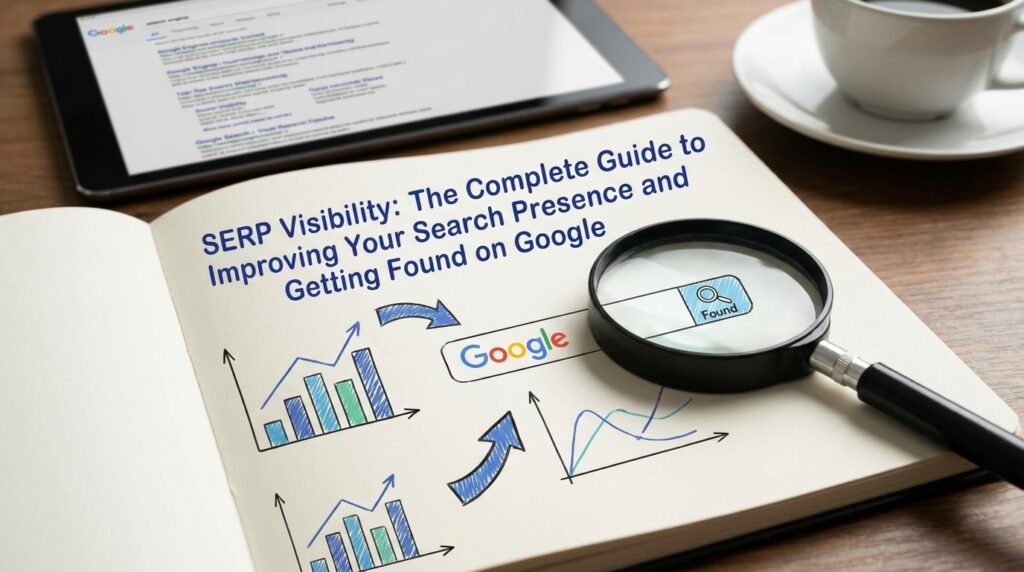
If your website is technically sound, publishes content regularly, and still seems invisible on Google, the problem may be your SERP visibility. Search engine results pages, or SERPs, are where your brand competes for attention against millions of other pages. A website can rank for hundreds of keywords and still receive little traffic if its pages rarely appear prominently, target the wrong searches, or fail to stand out in modern search results.
Understanding SERP visibility gives you a broader view of SEO. Instead of obsessing over one keyword position, you can evaluate how consistently your website appears across relevant searches, how much search real estate it occupies, and whether that visibility leads to meaningful clicks, leads, sales, or brand recognition.
Google’s search environment has also become more complex. Traditional organic listings now exist alongside featured snippets, image results, video results, local features, shopping results, AI Overviews, and other search features. Google has also expanded Search Console reporting and its guidance around content appearing across modern Search experiences.
This guide explains what SERP visibility means, why it matters, how it is measured, what affects it, and the practical SEO strategies businesses can use to increase their presence in Google Search.
What Is SERP Visibility?
SERP visibility refers to how prominently and frequently a website, webpage, or brand appears in search engine results for relevant queries.
It is broader than simply asking, “What position do I rank at?”
For example, imagine an accounting firm ranks at position three for one major keyword but does not appear for dozens of closely related searches. Another firm may rank at positions five through ten for hundreds of relevant queries, appear in local results, earn branded searches, and receive visibility through additional SERP features.
The second business may have greater overall SERP visibility, even though it does not hold the number-one position for the biggest keyword.
In practical SEO, visibility can include:
- Organic search rankings
- Search impressions
- Featured snippets
- AI-powered search features
- Local search appearances
- Image and video results
- Shopping results
- Branded search results
- Rich results
- People Also Ask appearances
- Multiple listings from the same website
Google’s Search Console data provides useful measurements such as clicks, impressions, click-through rate, and average position.
That makes SERP visibility a useful concept for evaluating SEO performance at a broader level.
Why SERP Visibility Matters for SEO
A website cannot generate organic search traffic from queries for which it is effectively invisible.
This sounds obvious, but many companies measure SEO using only a handful of high-volume keywords. That approach can hide substantial opportunities.
Suppose a website targets the keyword “best running shoes.” Ranking at position 18 may produce little traffic. However, the same website could rank on the first page for related searches such as “best running shoes for beginners,” “running shoes for flat feet,” “daily training running shoes,” and “comfortable running shoes for long distance.”
The combined visibility from those long-tail searches can become more valuable than one highly competitive keyword.
Strong SERP visibility therefore helps businesses reach users at different stages of the customer journey.
Someone searching for “how to choose running shoes” may be researching. Someone searching for “best running shoes under $150” may be comparing options. Someone searching for “buy men’s running shoes” may be ready to purchase.
A comprehensive SEO strategy attempts to become visible throughout that journey.
SERP Visibility vs. Rankings: What’s the Difference?
Rankings and SERP visibility are closely connected, but they are not identical.
A ranking tells you where a particular page appears for a particular query.
Visibility tells you how broadly and prominently your website appears across a collection of relevant searches.
Think of rankings as individual results and visibility as the bigger picture.
For example:
A company might rank #2 for one keyword, #7 for another, #9 for five related terms, and #15 for twenty additional searches. Looking at only the #2 ranking makes the SEO campaign appear excellent. Looking at the entire keyword portfolio provides a more realistic picture of its SERP visibility.
The reverse can also happen. A page may rank #1 for a low-value keyword that receives almost no searches.
That is why professional SEO analysis considers keyword relevance, search demand, impressions, clicks, conversion potential, and search intent—not position alone.
How Google Determines What Appears in Search
Google Search uses automated systems to discover, index, and rank content. The process is considerably more sophisticated than matching an exact keyword to a webpage.
Google evaluates numerous signals to determine which results are most useful for a particular search.
This means improving SERP visibility requires more than inserting a keyword repeatedly into an article.
Search engines need to understand:
- What your page is about
- Which questions it answers
- Whether the content satisfies the search intent
- How your page relates to the wider topic
- Whether the page can be crawled and indexed
- Whether your website demonstrates appropriate trust and expertise
- How your content compares with competing results
- Whether your page provides something genuinely useful
Google’s current guidance emphasizes helpful, reliable, people-first content rather than content created primarily to manipulate search rankings. Its documentation also explains that ranking systems use multiple signals and that improvements can sometimes produce ranking gains without waiting for a major core update.
For businesses, this creates an important principle: better SERP visibility usually comes from improving the usefulness, relevance, accessibility, and authority of your website—not from chasing individual algorithm tricks.
The Most Important Factors Affecting SERP Visibility
There is no single switch that turns visibility on. Instead, several SEO disciplines work together.
Search Intent
Search intent is one of the most important concepts in modern SEO.
Before optimizing a page, determine what the searcher actually wants.
Informational searches typically seek explanations or answers. Commercial investigation searches involve comparisons and research. Transactional searches indicate stronger purchase intent. Navigational searches usually involve finding a particular website or brand.
If someone searches “how to improve SERP visibility,” a detailed educational guide makes sense.
If someone searches “SERP visibility software,” a page comparing tools may be more appropriate.
If someone searches for a specific SEO agency, a service or company page may satisfy the intent better.
Matching the page format to the query can substantially improve SERP visibility because the content becomes more relevant to what users and search systems are trying to accomplish.
Topical Relevance
Modern search optimization is not limited to one exact phrase.
A page about SERP visibility should naturally discuss related concepts such as organic search, search rankings, impressions, CTR, keyword rankings, Google Search Console, SERP features, SEO performance, search intent, content optimization, technical SEO, backlinks, and organic traffic.
These related terms help establish topical context.
However, semantic SEO should never become keyword stuffing. The goal is to cover the topic naturally and comprehensively.
A strong article answers the primary question while anticipating the follow-up questions a reader is likely to have.
Content Quality and Originality
Publishing 100 generic articles does not necessarily create better SERP visibility than publishing 30 genuinely useful resources.
Quality content should demonstrate a reason for existing.
Ask:
Does this page provide original analysis?
Does it contain practical examples?
Does it answer questions competitors overlook?
Does it reflect real experience?
Does it cite credible evidence where appropriate?
Does it give readers something they cannot easily get from ten other pages?
Google’s 2026 guidance increasingly emphasizes non-commodity content and people-first usefulness, particularly as Search expands into AI-powered experiences.
Technical SEO
Technical problems can limit SERP visibility even when content is excellent.
Search engines need to be able to discover, crawl, render, and index important pages.
Technical SEO includes areas such as:
- Crawlability
- Indexation
- XML sitemaps
- Robots directives
- Canonical URLs
- Internal linking
- Mobile usability
- HTTPS
- Page performance
- Structured data
- JavaScript rendering
- Redirect management
- Duplicate content control
Canonicalization is particularly important on websites with multiple versions of similar pages. Google explains that canonicalization helps select the representative URL from duplicate or substantially similar versions.
A technically clean website gives search engines a clearer understanding of which pages matter.
Internal Linking
Internal links help users and search engines discover related content.
Imagine you publish a detailed guide about SERP visibility, another article about keyword research, and another about technical SEO.
Linking these resources together creates a logical topic structure.
For example, your SERP visibility guide could link to your keyword research guide when discussing search demand. Your keyword research article could link back to the visibility guide when explaining how keyword portfolios are evaluated.
This can strengthen topical relationships while improving navigation.
Backlinks and Authority
Quality backlinks can help search engines discover and evaluate content.
However, the objective should not be collecting thousands of random links.
A relevant editorial link from a respected publication in your industry can be more meaningful than a large collection of unrelated links.
Effective link acquisition can come from original research, expert commentary, useful resources, digital PR, partnerships, statistics, studies, and genuinely link-worthy content.
Third-party authority metrics such as Domain Authority or Domain Rating can help with competitive analysis, but they should not be treated as Google’s own ranking scores.
As Google’s Gary Illyes has explained, Google does not use an overall “domain authority” metric in the way many third-party tools define it.
User Experience
A page that ranks but frustrates visitors is not a successful SEO asset.
Good UX means the visitor can quickly understand what the page offers, navigate it easily, read it comfortably, and complete the intended action.
This includes clear headings, readable typography, logical navigation, mobile-friendly design, useful media, fast interactions, and concise answers.
Good UX can also improve business outcomes even when it is not directly equivalent to a ranking factor.
How to Measure SERP Visibility
The most reliable way to evaluate SERP visibility is to combine several metrics.
Google Search Console is especially valuable because it provides first-party search performance data.
Impressions
An impression indicates that your result was shown in Google Search.
If impressions are increasing, your website is appearing for more searches or appearing more frequently for existing searches.
High impressions with low clicks can indicate an opportunity to improve titles, snippets, search intent alignment, or the page’s competitive positioning.
Average Position
Average position gives you a broad indication of where your pages appeared across queries.
It should not be interpreted as a single fixed ranking because a page can appear at different positions for different searches, locations, devices, and users.
Still, changes in average position can help identify trends.
Click-Through Rate
CTR measures the percentage of impressions that resulted in clicks.
A page receiving 10,000 impressions and 500 clicks has a 5% CTR.
CTR should be interpreted carefully because SERP layouts vary considerably. Ads, maps, videos, featured content, shopping results, and AI features can all affect how much attention traditional organic listings receive.
Organic Clicks
Clicks tell you whether visibility is actually bringing visitors.
Increasing impressions without increasing clicks may mean you are gaining visibility for lower-position or lower-intent searches.
Increasing both impressions and clicks is generally a stronger indication of organic growth.
Keyword Coverage
Keyword coverage measures how many relevant queries your website appears for.
Instead of tracking only five target keywords, build a portfolio of primary, secondary, long-tail, branded, informational, commercial, and transactional terms.
This gives you a much more accurate picture of SERP visibility.
A Simple SERP Visibility Example
Consider a fictional home remodeling company called BrightBuild.
Initially, BrightBuild ranks for only 40 relevant keywords.
Most of its pages target broad terms such as “home remodeling.”
The company then conducts a search-intent analysis and discovers customers search for:
“bathroom remodeling ideas”
“average bathroom remodel cost”
“small kitchen renovation ideas”
“kitchen remodeling contractor”
“basement finishing ideas”
“home renovation checklist”
Instead of publishing generic content, BrightBuild creates dedicated resources for these search intents.
It improves internal links, updates old pages, adds original project examples, improves service-area pages, earns relevant local mentions, and fixes technical indexation issues.
After several months, BrightBuild appears for hundreds of relevant queries.
The company may still not rank #1 for “home remodeling,” but its total SERP visibility has increased significantly.
More importantly, the new visibility reaches users at different stages of the buying journey.
How to Increase SERP Visibility Step by Step
Start With a SERP Audit
Search your primary topics manually.
Study the current results.
Look for patterns.
What content formats dominate?
Are the top results guides, product pages, comparison articles, videos, local businesses, or forums?
What questions appear repeatedly?
Which topics are missing?
A SERP audit reveals what Google appears to consider useful for a query.
Build Topic Clusters
Instead of creating isolated articles, build connected topic clusters.
For example, an SEO website could have a central pillar page about search engine optimization supported by articles covering technical SEO, keyword research, content strategy, link building, local SEO, SERP features, and Search Console.
This approach increases topical depth and creates more opportunities for SERP visibility.
Optimize Existing Content
One of the fastest opportunities often exists in pages you already have.
Look for pages receiving impressions but few clicks.
Look for keywords ranking between positions 5 and 20.
Look for articles ranking for unexpected queries.
Then improve them.
Add missing sections, clarify the introduction, improve examples, update outdated information, strengthen internal links, improve title tags, and address unanswered search intent.
Do not rewrite content simply to make it longer.
Improve it because the current version does not fully satisfy the user.
Improve Title Tags and Snippets
Your title is often the first thing a searcher notices.
A strong title should clearly communicate the page’s value without becoming misleading or clickbait.
For example:
Weak: “SEO Tips”
Better: “SEO Tips for Small Businesses: 15 Practical Ways to Increase Organic Traffic”
The second title provides clearer context and a stronger reason to click.
Remember that Google can generate search-result snippets from page content rather than simply displaying the meta description exactly as written.
Strengthen E-E-A-T Signals
Experience, expertise, authoritativeness, and trust can help make content more credible.
For businesses, demonstrate real-world experience.
Include original examples, author information, editorial standards, sources, methodology, customer outcomes where appropriate, and transparent business information.
An SEO article written by someone with practical experience should not sound like a generic collection of definitions.
It should explain what actually happens when strategies are implemented.
Create Content Worth Citing
One powerful way to grow SERP visibility is to create resources other websites want to reference.
Original statistics, surveys, research summaries, calculators, templates, detailed case studies, expert interviews, and industry analyses can naturally attract mentions.
Think beyond “How can I rank?”
Ask:
“What can I publish that becomes a useful reference for other people?”
That shift can improve both authority and discoverability.
SERP Features and Search Visibility
Traditional blue links are no longer the entire search experience.
Modern SERPs can include featured snippets, image packs, video results, local packs, shopping experiences, news features, People Also Ask, and AI-powered experiences.
This means SERP visibility should increasingly be viewed as search real estate rather than a single ten-position list.
For example, a recipe website may gain visibility through organic results, images, videos, and recipe-specific search experiences.
A local business may appear through local search features as well as traditional organic pages.
A publisher may gain additional exposure through Google News and other Search surfaces.
Google has also introduced tools and documentation around preferred sources, including visibility within Top Stories and, where available, AI Mode and AI Overviews.
The SEO strategy should therefore reflect the way your audience actually searches.
Common SERP Visibility Mistakes
One common mistake is focusing exclusively on rankings.
Another is targeting keywords without understanding search intent.
Some businesses also publish large amounts of AI-generated or generic content without adding original expertise.
Others neglect technical SEO, leaving valuable pages unindexed or competing with duplicate URLs.
Another problem is abandoning content too quickly.
SEO often requires iterative improvement. A page that ranks at position 14 may have substantial potential. Improving its comprehensiveness, internal linking, intent alignment, authority, and user experience can move it into more valuable positions.
Finally, some businesses measure success using vanity metrics.
A rising keyword count is encouraging, but what matters commercially is whether relevant visibility generates qualified traffic, leads, sales, subscriptions, or other meaningful outcomes.
Expert Insight for Better SEO Decisions
A useful principle from Google’s Search team is that SEO should not be reduced to manipulating isolated ranking signals.
John Mueller has emphasized the broader purpose of search optimization: “Google wants to show content that fulfills people’s needs.”
That principle is especially important when developing a long-term SERP visibility strategy.
Instead of asking, “How many times should I use my keyword?” ask, “What does the searcher need after typing this query?”
Instead of asking, “How do I beat this competitor?” ask, “What valuable information have they failed to provide?”
Instead of asking, “How can I create 50 articles this month?” ask, “Which topics deserve the strongest resources?”
Those questions lead to more sustainable SEO decisions.
A Practical SERP Visibility Checklist
Before publishing an important page, evaluate its fundamentals.
Does the page clearly satisfy the intended search query?
Does the title accurately describe the benefit?
Is the primary topic immediately understandable?
Does the content cover important related questions?
Does it demonstrate first-hand experience or credible expertise?
Are supporting claims backed by trustworthy sources?
Can Google crawl and index the page?
Is the canonical URL correct?
Does the page have useful internal links?
Is it mobile-friendly?
Does the page load efficiently?
Does it offer something meaningfully better or different from competing results?
Can the page potentially earn links, citations, or mentions?
After publication, monitor impressions, clicks, CTR, rankings, conversions, and the queries generating visibility.
Then improve the page based on evidence.
Frequently Asked Questions
What is SERP visibility in SEO?
SERP visibility describes how frequently and prominently a website appears across relevant search engine results. It considers more than one keyword ranking and can include organic listings, search features, impressions, and broader search presence.
How do I check my SERP visibility?
Google Search Console is one of the best starting points. Review impressions, clicks, CTR, average position, queries, and pages. SEO platforms can supplement this information with keyword tracking and competitor analysis.
Is SERP visibility the same as ranking?
No. Ranking refers to a page’s position for a particular query, while SERP visibility describes broader search presence across multiple relevant queries and search features.
Why is my website getting impressions but few clicks?
Possible causes include low rankings, weak title tags, poor search-intent alignment, competitive SERPs, or search features that reduce attention on traditional organic results. Review the queries generating impressions and compare your result with the current SERP.
How long does it take to improve SERP visibility?
There is no universal timeline. Results depend on competition, website history, technical health, content quality, authority, search demand, and the scale of improvements. Some changes can produce relatively quick gains, while competitive topics may require sustained SEO work.
Can AI content improve SERP visibility?
AI can assist with research, outlining, editing, and content production, but simply generating large volumes of generic material is not a reliable strategy. Content should provide genuine value, accuracy, originality, and appropriate expertise. Google’s guidance emphasizes people-first, useful content rather than content created primarily to manipulate rankings.
Conclusion: Build Visibility, Not Just Rankings
Strong SERP visibility is the result of many connected SEO efforts working together.
Search intent tells you what users need. Quality content gives them useful answers. Technical SEO makes those answers accessible to search engines. Internal linking creates meaningful relationships between pages. Authority and trust strengthen your overall presence. Search Console data tells you what is actually happening.
The biggest mistake is treating SEO as a race to position one.
Your real objective should be to become consistently visible for the searches that matter to your audience.
Track impressions. Study queries. Improve pages that already show potential. Build topic depth. Create original resources. Fix technical problems. Earn legitimate authority. And continually compare your content against what searchers actually see.
When you approach SEO this way, SERP visibility becomes more than a metric. It becomes a framework for building a website that is easier to discover, easier to trust, and more useful to the people who matter most to your business.
If your website is receiving impressions but not enough qualified traffic, a focused SEO audit can reveal where your biggest visibility opportunities are and which improvements should come first.