What Headless WordPress vs Shopify for Ecommerce Actually Means in Practice
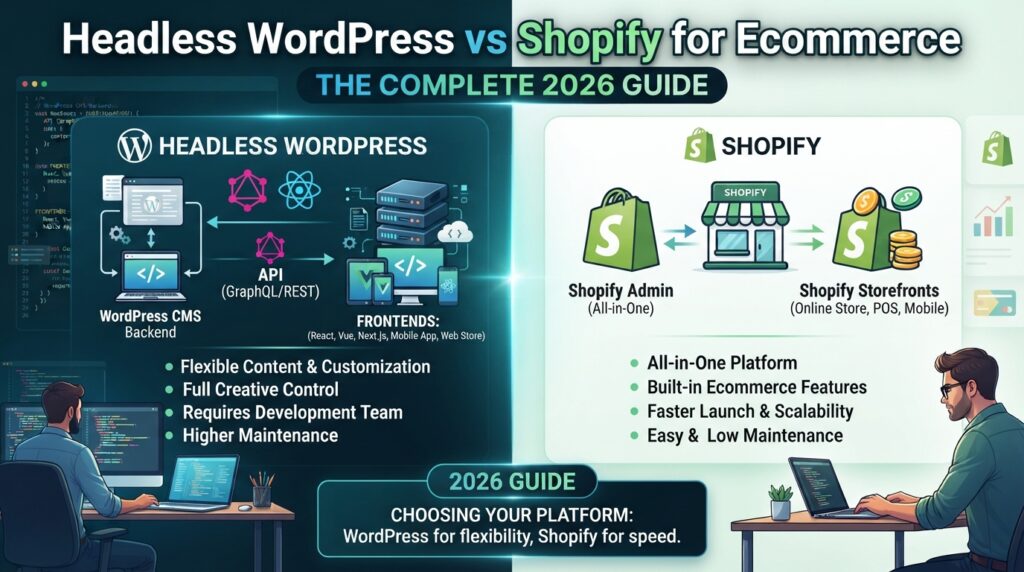
A themed WooCommerce site with a PHP frontend is not headless. Neither is a stock Shopify theme. A platform only counts as headless once the frontend is architecturally separated and calling the platform through a real API, not just because it exposes REST endpoints. Yournextstore
For WordPress, that separation means WooCommerce plus WPGraphQL (or CoCart for a lighter REST-based cart) feeding a JavaScript frontend. For Shopify, it means the Storefront API feeding Hydrogen or a custom React or Next.js build, while checkout, inventory, and order data stay on Shopify’s servers.
This distinction changes the entire headless WordPress vs Shopify for ecommerce comparison. You are never really comparing “WordPress vs Shopify.” You are comparing a self-assembled open-source stack against a commerce platform with a headless layer bolted on.
Real Cost Breakdown: What Each Stack Costs in 2026
Cost is where most competing guides get vague. Here are the actual numbers.
A themed WooCommerce build is best for businesses that already run WordPress, need heavy customization, or want full data ownership, with hosting typically running €20 to €100 a month and premium plugins adding €50 to €300 a year on top of developer hours for security patching and plugin conflicts. ICTLAB
Going fully headless on the WordPress side adds a second hosting bill. WP Engine Atlas starts at $49 a month and bundles WordPress hosting, Node.js frontend hosting, and WPGraphQL into one bill, which simplifies things compared to running separate WordPress and Vercel environments. Agencies running ten client sites on split hosting setups end up paying for two infrastructures per client, and that overhead compounds fast. Ben Ryan
On the Shopify side, a Basic plan runs $39 a month plus a 2% transaction fee if you skip Shopify Payments, apps typically cost $100 to $500 a month, and themes range from free to $400, or $4,000 to $15,000 for a fully custom build. Headless Shopify is a different budget entirely. Custom Hydrogen or Next.js builds on top of Shopify typically run $20,000 to $130,000 or more, and one detailed breakdown put realistic monthly operating costs at roughly $4,579, split between the Shopify plan, CMS tooling, and engineering support. Shopify vs WooCommerce vs Headless Commerce 2026 +2
That means headless WordPress vs Shopify for ecommerce, at the fully decoupled level, is rarely a cheap-vs-expensive comparison. Both paths get expensive once you add a real frontend team. A headless build generally costs 1.5 to 2.5 times more than an equivalent themed build, regardless of which backend you start from. IWD Agency
Performance and Core Web Vitals: Where Headless Actually Pays Off
Speed is the single biggest reason merchants consider going headless at all. Decoupling the frontend from server-rendered templates lets pages load faster and respond quicker to interaction, which is the core promise behind headless WordPress vs Shopify for ecommerce discussions. Datronix Tech
Production data backs this up on the Shopify side. One migration from Salesforce Commerce Cloud to headless Shopify made a storefront three times faster, and a headless Shopify build for a bicycle brand hit an 80-plus Lighthouse score while running a 100-combination product configurator across four languages. Ask Phill
On the WordPress side, the gains are just as real but depend more on discipline. Astro-based frontends ship close to zero JavaScript by default, which matters directly for Core Web Vitals on content-heavy category and blog pages. A caching layer alone will not get a themed WooCommerce store to that level.
The honest takeaway on headless WordPress vs Shopify for ecommerce performance: both platforms can hit excellent Core Web Vitals scores headless. Neither hits those scores reliably while still running a traditional theme.
Total Cost of Ownership: Twelve Months In
Sticker price and year-one reality rarely match. WooCommerce often starts cheaper on paper, but hosting upgrades, plugin conflicts, security work, and developer hours accumulate into a technical tax just to keep the store running. Shopify converts most of that into one predictable monthly line item. HTML Burger
Once plugins, hosting, security, and maintenance are factored in, WooCommerce typically costs the same as or more than Shopify’s higher-tier plans over a full year, which flips the “WordPress is free” assumption most founders start with. Pixel Movers
This is the part of the headless WordPress vs Shopify for ecommerce debate that decides most real budgets: it’s rarely about the platform license. It’s about who is on the hook for uptime, security, and the three a.m. plugin conflict.
Developer Skill Requirements and Hiring Reality
Headless anything raises your hiring bar. A themed WooCommerce or Shopify store can be maintained by a competent generalist. A headless build on either platform needs someone fluent in React, GraphQL or REST API design, and modern deployment pipelines.
Vetting a headless developer matters more than the platform choice: ask for live storefronts they have actually shipped, verify they are using the Storefront API, GraphQL, and server-side rendering in their own code rather than a renamed starter template, and confirm what happens to your project if that developer becomes unavailable. Weaverse
For WooCommerce headless builds specifically, checkout logic is the recurring failure point. Checkout, cart, and payment gateway support through the REST API remain partial or broken for anything beyond the simplest flows, which is the mistake that costs teams real money after the fact. Shopify’s Storefront API and Customer Account API avoid that problem because checkout, cart, and payments are commerce-native, not bolted onto a CMS. Ben Ryan
SEO Control: Headless WordPress vs Shopify for Ecommerce on Search Visibility
WordPress holds an edge here because of its vast ecosystem of dedicated SEO tools, though Shopify still covers core SEO fundamentals effectively and integrates well with commerce features. WordPress generally offers more control over technical SEO, while Shopify provides solid built-in tools that cover most on-page needs. 6th Mansemrush
Where Shopify has historically lost ground is URL structure flexibility. Shopify restricts some technical changes, like URL structures, though it still handles core SEO basics well. Headless WordPress removes that restriction entirely, since your frontend controls routing directly. 6th Man
For a content-heavy brand where blog traffic feeds product discovery, that flexibility tips the headless WordPress vs Shopify for ecommerce decision toward WordPress. For a brand where SEO is secondary to conversion speed, Shopify’s constraints rarely matter in practice.
Migration Risk: What Happens When You Outgrow Your First Choice
Nobody plans to migrate platforms twice, but plenty of merchants do. Moving from Shopify to a headless frontend on the same Shopify backend is the cleanest migration path since product and order data never move, typically taking six to ten weeks, while moving from Shopify to WooCommerce is almost never the right call and usually signals a business problem, not a platform one. Pixel Movers
There’s also a quieter migration risk specific to Shopify’s headless layer. Shopify deprecated legacy customer accounts and the old Multipass authentication method in February 2026, replacing it with the OAuth-based Customer Account API, so any older headless build still running Multipass has a forced migration ahead. Roboto Studio
On the WordPress side, migration risk looks different. Plugin abandonment, WPGraphQL breaking changes, and hosting lock-in with platforms like WP Engine Atlas are the equivalent long-term risks.
AI and GEO Readiness for 2026 and Beyond
This is the gap most competing articles on headless WordPress vs Shopify for ecommerce skip entirely. A headless stack is the easiest architecture to add real AI features to, including retrieval-augmented product search, AI styling assistants, and agent-driven reordering, because the modern frontend is already built for that kind of integration. Shopify Magic covers product descriptions and basic image edits well for most small stores, but anything beyond that still requires custom development. Teamz LabTeamz Lab
For citations inside AI Overviews, SearchGPT, and Perplexity, structured data and clean, crawlable content matter more than the platform badge. Both stacks can be optimized for GEO. Headless setups simply give you more direct control over how that data gets served.
Security, PCI Compliance, and Who Owns the Risk
This gets skipped in most comparisons, and it shouldn’t be. Payment security liability does not disappear just because your storefront looks modern.
On Shopify, PCI DSS compliance is handled by Shopify itself, whether you run a themed store or a headless Hydrogen build. Checkout routes through Shopify’s hosted checkout or the Customer Account API, so the sensitive payment surface never touches your custom frontend code.
Headless WooCommerce is a different story. Once you decouple checkout through CoCart or a custom REST integration, PCI scope can expand depending on how payment data flows through your frontend. That decision has to be made deliberately. It is not the default.
For a US merchant, a misconfigured headless WooCommerce checkout that touches raw card data even briefly can pull your business into a higher PCI compliance tier, with real audit costs attached. Ask any developer quoting a headless WooCommerce build exactly how payment data flows before signing a contract.
Hosting, Deployment, and Team Workflow
The operational side of this decision gets less attention than cost or speed, but it shapes daily life for whoever runs the store after launch.
A headless WordPress build typically means two separate deployment pipelines. WordPress and WooCommerce updates happen on one host, while the Next.js or Astro frontend deploys separately through Vercel or Netlify. Content editors need training on how a WordPress edit actually reaches the live frontend.
Shopify Hydrogen keeps this simpler in most cases. Oxygen hosting deploys alongside your Shopify backend, so there is one vendor relationship and one support line when something breaks.
If your internal team is small, or marketing owns content updates without a developer on standby, that difference in operational overhead should weigh as heavily as the sticker price when you’re working through headless WordPress vs Shopify for ecommerce.
When to Choose Headless WordPress
Headless WordPress fits three recurring situations. Your brand is content-first with commerce as a secondary revenue stream. Your team already has WordPress expertise in-house. Or you need full data ownership and aren’t comfortable with a SaaS platform holding your product and customer records.
If you’re WordPress-first already, with a content-heavy blog and commerce added on top, that’s the clearest signal to stay on WooCommerce rather than replatforming. Going headless from there is a performance upgrade, not a full migration. Teamz Lab
When to Choose Shopify (or Shopify Hydrogen)
Shopify remains the default choice for roughly 80 percent of new stores because it launches fastest, has the strongest app ecosystem, and ships a checkout experience that just works. Even agencies that specialize in headless builds report talking most brands who came in wanting headless into native Shopify Plus instead, because headless is a different architecture with real trade-offs, not an automatic upgrade. Teamz LabAsk Phill
Reach for Hydrogen specifically when you need multi-brand or multi-region storefronts on one backend, checkout customization Shopify’s standard theme genuinely cannot deliver, or content-heavy marketing pages that need sub-second load times alongside commerce.
If your team at Aura Core Digital has already scoped a Shopify build, ask specifically whether Hydrogen or a themed store fits your actual traffic before committing budget to a headless rebuild.
Actionable Summary: Key Takeaways
- Headless WordPress vs Shopify for ecommerce is really a comparison of a self-assembled open-source stack against a commerce platform with a headless layer added.
- Full headless builds on either platform run 1.5 to 2.5 times the cost of a themed store, so validate the business case before committing.
- WooCommerce’s REST API still has partial or broken checkout support in places; WPGraphQL and Faust.js close most of that gap for content, not commerce logic.
- Shopify Hydrogen and the Customer Account API make headless Shopify builds more stable in 2026, following the Multipass deprecation.
- WordPress keeps the edge on technical SEO flexibility, including URL structure control that Shopify still restricts.
- Roughly 80 percent of new stores are still better served by a themed Shopify build than a headless one.
- Headless architecture is the easier foundation for adding AI-driven product search and agent-based shopping features later.
- Match the platform to your team’s actual technical capability, not to which option sounds more sophisticated.
Ready to Choose the Right Stack? Talk to Aura Core Digital
Picking between headless WordPress vs Shopify for ecommerce is not a decision to make from a comparison article alone. Every brand’s traffic pattern, content strategy, and growth trajectory changes the answer.
Aura Core Digital scopes both WordPress and Shopify ecommerce builds for US merchants, and we’ll tell you honestly when headless is overkill for your current stage. Get in touch with our team for a straight read on which stack fits your store, your budget, and your timeline before you spend a dollar on development.
Frequently Asked Questions
Is headless WordPress more expensive than Shopify for ecommerce?
It depends on the build, not the platform. A themed WooCommerce store is often cheaper upfront than Shopify, but headless versions of both platforms land in a similar range once frontend development and dual hosting are factored in.
Can WooCommerce handle checkout on a headless WordPress ecommerce build?
Checkout is the weakest part of headless WooCommerce. REST API support for cart, payment gateways, and order management is partial or broken in places, so most serious headless WooCommerce builds add CoCart or WPGraphQL for WooCommerce to close the gap.