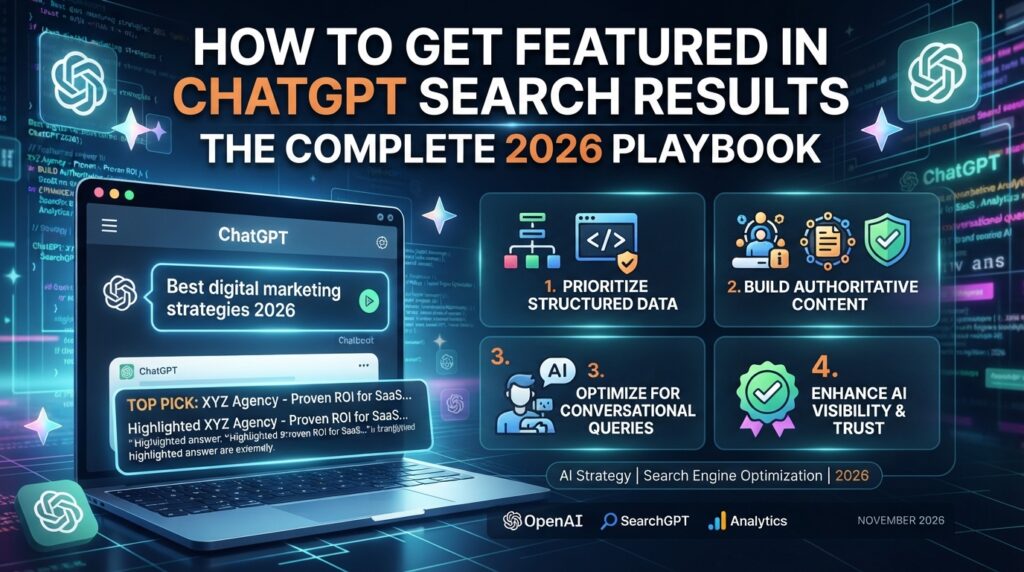
Figuring out how to get featured in ChatGPT search results has become one of the highest-leverage marketing questions of 2026, because a growing share of buyers now ask ChatGPT for a recommendation instead of typing a query into Google. AI-referred visitors convert at several times the rate of a typical organic click, mainly because the model has already vetted the source before the person ever lands on your site. That changes the incentive structure completely: the citation itself is the new impression, and sometimes the new sale.
Most guides on this topic recycle the same three tips: “write good content,” “add schema,” and “get backlinks.” None of that is wrong, but none of it explains why two businesses with similar content quality get wildly different citation rates. This playbook is built from a fresh competitor teardown of what’s currently ranking for this exact question, plus the technical realities that most of those articles skip entirely.
Search behavior itself has shifted enough to justify the effort. A large and growing share of Google queries now end without a click at all, because an AI Overview answers the question directly on the results page. ChatGPT search extends that same behavior into its own interface, and it’s rapidly becoming a default research tool rather than a novelty. Businesses that treat this as a passing trend are the ones most likely to be invisible in twelve months.
What “Getting Featured in ChatGPT” Actually Means
Before you chase tactics, it helps to separate two very different systems that people lump together under “ChatGPT search.”
The first is the base model’s training data, the text OpenAI used to build the model itself. You have almost no direct control over this, and it updates on a slow release cycle. The second is live browsing, where ChatGPT search pulls in real-time web results the way a search engine does. Learning how to get featured in ChatGPT search results is really about optimizing for this second system, because it’s the one that responds to changes you make this quarter, not this decade.
OAI-SearchBot vs. GPTBot: The Distinction Almost Everyone Gets Wrong
Nearly every competing article on this topic tells you to “allow GPTBot in robots.txt” and stops there. That advice is incomplete and can actually work against you.
GPTBot is OpenAI’s training crawler. Blocking it tells OpenAI not to use your content to train future foundation models, it has nothing to do with whether you show up in a live ChatGPT search answer today. The bot that actually matters for how to get featured in ChatGPT search results is OAI-SearchBot, the crawler OpenAI uses specifically to index pages for ChatGPT’s search feature. OpenAI has stated plainly that sites opted out of OAI-SearchBot will not appear in ChatGPT search answers.
The practical fix is simple. In your robots.txt, explicitly allow OAI-SearchBot regardless of what you decide about GPTBot for training purposes. You can opt out of training and still be fully eligible for search citations, and most brands should do exactly that.
Bing Indexing Is Still the Foundation
ChatGPT’s browsing and search features are built on top of Microsoft’s Bing index, and research comparing citation overlap has found a very high correlation between what ranks on Bing and what gets cited by ChatGPT. If you have spent years optimizing exclusively for Google and ignoring Bing Webmaster Tools, that gap is probably the single biggest reason you aren’t showing up yet.
Submit your XML sitemap to Bing Webmaster Tools, verify your site, and check for crawl errors the same way you would in Google Search Console. This single step resolves more visibility problems than any amount of schema tinkering, and it’s the part of how to get featured in ChatGPT search results that gets the least attention because it isn’t a flashy tactic.
Many businesses discover during this audit that Bing has never fully indexed key service pages, sometimes for years, simply because nobody submitted a sitemap or fixed a redirect chain Bing flagged as an error. That gap alone can explain why a competitor with thinner content consistently outranks a stronger site in AI answers. Fix the indexing plumbing before you touch a single word of copy.
It’s also worth checking Bing’s URL Inspection tool page by page for your highest-priority services, the way you’d use Google’s equivalent tool. A page that returns a soft 404 or a slow server response in Bing’s crawler logs will rarely make it into a live answer, regardless of how well it’s written.
Structure Content Into Extractable Answer Capsules
ChatGPT’s retrieval system doesn’t pull entire pages into an answer. It pulls short passages, typically in the 100 to 200 word range, that directly answer the query. If your page buries the actual answer three paragraphs into a rambling introduction, the model has nothing clean to lift.
Put a two-to-three sentence “answer capsule” near the top of every important page and every major section. Answer the question plainly before you explain the nuance. This one habit is the difference between content that gets summarized accurately and content that gets skipped in favor of a competitor’s tighter paragraph.
A few formatting habits that support extractability:
- Lead each section with the direct answer, not a windup.
- Use semantic subject-predicate-object sentences instead of vague marketing language.
- Keep paragraphs short, three lines or less, so a chunking algorithm doesn’t have to guess where an idea starts and ends.
- Use descriptive H2 and H3 headers that read like the questions your audience actually types.
Does Schema Markup Actually Help You Get Featured in ChatGPT Search Results?
This is where the SEO industry is currently split, and it’s worth being honest about it instead of repeating the hype.
Controlled testing published in early 2026 found that ChatGPT and Perplexity tokenize JSON-LD as raw text rather than parsing it as structured data the way Google does. That means FAQPage or Article schema doesn’t get “read” by ChatGPT the way many AEO guides imply. Google also removed FAQ rich results from standard search in May 2026, closing off one of the traditional reasons to invest heavily in FAQ markup.
None of that means schema is worthless. Schema still strengthens your entity presence in Google’s Knowledge Graph, and a large share of AI Overview citations come from pages that already rank in the top ten organically. So schema helps indirectly, by improving the Google visibility that feeds AI answers, rather than by being read directly during a ChatGPT search.
The practical takeaway on how to get featured in ChatGPT search results: keep Article and Organization schema in place for entity clarity, but put your real effort into visible, on-page Q&A content and topical authority rather than treating schema as a citation shortcut.
Build Topical Authority With Content Clusters, Not One-Off Posts
A single well-optimized article rarely moves the needle on its own. ChatGPT looks for sources that cover a topic thoroughly across multiple connected pieces, because depth signals that a site actually knows the subject rather than publishing one lucky post.
If your core service is digital marketing, don’t stop at one guide. Build out connected resources covering the sub-topics your audience searches around it: local SEO, content strategy, paid social, and web development, all linking to each other with natural anchor text. That interlinked structure is a large part of how to get featured in ChatGPT search results consistently rather than for a single lucky query.
A useful way to plan a cluster is to list every question a genuinely confused customer would ask before hiring you, then map each question to a page. If ten of those questions currently point to a single blog post, split it into ten focused pages instead. Depth per question beats breadth crammed into one document, both for a human reader and for a model deciding which passage best answers a specific query.
Refresh dates matter here too. A cluster built in 2023 and never touched again starts to look stale next to a competitor updating their pages quarterly with new statistics, screenshots, and examples. Content freshness is one of the few signals every major AI search system agrees matters, so put a recurring review date on every page in the cluster rather than treating publication as a one-time event.
Earn Third-Party Mentions and Independent Citations
A site with modest Google rankings but strong third-party coverage can still surface in ChatGPT responses, because the model draws on forums, review sites, industry publications, and social platforms in addition to your own domain. This is the layer most businesses under-invest in.
Practical ways to build this layer:
- Contribute expert commentary to trade publications and podcasts in your niche.
- Get listed and reviewed on the directories relevant to your industry.
- Encourage detailed customer reviews that mention specific services, outcomes, and locations.
- Pursue digital PR that earns genuine mentions, not just links for link’s sake.
Consistent entity signals matter here too. Your business name, address, service descriptions, and credentials should match, word for word, across your website, directories, and social profiles. Inconsistent details make it harder for a model to confidently verify who you are, and an unconfident model tends to cite a competitor instead.
Run this audit at least once a quarter. Search your exact business name plus “reviews,” “alternative,” and your city to see what’s actually indexed about you right now. It’s common to find an old address, a discontinued service, or a former employee still listed as the contact on a directory nobody’s touched in two years. Every one of those small inconsistencies chips away at the confidence a model needs before it will name you directly in an answer.
The 2026 robots.txt and llms.txt Checklist
Treat these as separate, complementary tools rather than one solving the other’s job.
robots.txt controls crawler access. Audit it today by opening yourdomain.com/robots.txt and checking for GPTBot, OAI-SearchBot, PerplexityBot, ClaudeBot, Claude-SearchBot, and Google-Extended. Decide your training-data policy independently from your search-visibility policy, and make sure sensitive paths stay blocked for every bot.
llms.txt is a newer, optional file that points AI systems toward your best content. The honest 2026 data shows adoption sits around 10 to 20 percent even among large sites, and large-scale bot-traffic analysis has found that major crawlers still overwhelmingly request standard HTML pages rather than checking for this file. It costs about twenty minutes to add and won’t hurt anything, so treat it as cheap insurance rather than a core strategy for how to get featured in ChatGPT search results.
Write for the Way People Actually Ask ChatGPT Questions
Google queries tend to be short and fragmented: “best plumber Austin.” ChatGPT queries tend to be longer and conversational: “who’s a reliable plumber in Austin that handles emergency calls on weekends.” That difference changes what content actually matches the query.
Audit your existing content for whether it answers the long, specific version of the question or only the short keyword version. A page optimized purely around a two-word keyword phrase often reads as generic to a conversational query, even if it technically ranks for that keyword in Google. Rewriting key pages to directly answer the fuller, more natural question is one of the more overlooked levers in how to get featured in ChatGPT search results, precisely because it doesn’t show up in a traditional keyword research tool.
Practical steps for this rewrite:
- Pull the actual chat transcripts or support tickets where customers phrase their real questions, and mirror that language on the page.
- Address qualifiers people naturally include, like budget, location, timeline, and urgency, directly in the copy.
- Avoid marketing language that answers “why choose us” before answering “what is this and does it solve my problem.”
Common Mistakes That Quietly Block AI Visibility
A handful of avoidable errors show up again and again in site audits, and each one undermines the work above.
- JavaScript-rendered content with no server-side fallback. Some AI crawlers are far less sophisticated than Googlebot at executing JavaScript, so critical text hidden behind client-side rendering may never be seen at all.
- Thin, templated location pages. Fifty pages that only swap a city name provide no additional information for a model to cite, and can actively read as low-quality.
- No clear authorship or publication dates. Anonymous, undated content offers no freshness or expertise signal for a model weighing which source to trust.
- Aggressive pop-ups or gated content on informational pages. If the answer is behind an email-capture wall, most crawlers simply move on to a competitor’s open page.
- Ignoring Bing entirely. As covered above, this is the single most common gap, and it’s rarely on anyone’s roadmap.
Fixing even two or three of these on your highest-traffic pages often produces a bigger jump in AI visibility than a month of new content production.
Measuring Whether You’re Actually Getting Cited
Traditional rank tracking won’t tell you this story. A page can sit in position five organically and still be the first source cited in an AI answer, or rank first and never get mentioned at all.
Run manual spot checks weekly: ask ChatGPT search direct questions your customers would ask, along with comparison queries like “best [your category] near me” or “alternatives to [competitor].” Note whether your brand appears, how it’s described, and whether the details are accurate. Document every gap between reality and what the model says, because outdated or missing details are usually fixable with a content update.
Key Takeaways
- Allow OAI-SearchBot in robots.txt specifically, separate from your GPTBot training decision, since search indexing and training crawlers serve different purposes.
- Strong Bing visibility is a near-prerequisite because ChatGPT’s browsing and search features run on the Bing index.
- Place a direct, two-to-three sentence answer capsule at the top of every important page and section.
- Schema markup helps indirectly through Google rankings; it is not reliably parsed as structured data by ChatGPT itself.
- Build interlinked content clusters instead of isolated posts to demonstrate topical depth.
- Earn third-party mentions across directories, reviews, and trade publications, since ChatGPT draws on sources beyond your own site.
- Keep your business details identical across every platform to strengthen entity confidence.
- Track AI citations manually with weekly spot-check queries, since traditional rank tracking won’t capture this.
Ready to Get Featured in ChatGPT Search Results? Work With Aura Core Digital
Figuring out how to get featured in ChatGPT search results on your own takes ongoing technical audits, content restructuring, and consistent tracking that most in-house teams don’t have time for. Aura Core Digital builds this into a repeatable system: Bing and crawler audits, answer-capsule content rewrites, entity consistency checks, and monthly AI-citation tracking, all built around your actual service pages.
If you want a clear picture of where your site stands today, contact Aura Core Digital for a free AI-visibility audit. We’ll show you exactly which pages are citable right now and which ones are quietly invisible to ChatGPT.
Frequently Asked Questions
Does blocking GPTBot hurt my chances of appearing in ChatGPT search results?
No, blocking GPTBot alone does not hurt your search visibility. GPTBot governs training data collection, while OAI-SearchBot governs live search indexing. You can disallow GPTBot for training purposes and still allow OAI-SearchBot for full search eligibility.
How long does it take to start showing up after making these changes?
Expect roughly six to twelve weeks for ChatGPT’s browsing-based search results to reflect changes, since it depends on Bing’s crawl and re-index cycle. Faster-refreshing engines like Perplexity can show movement in as little as two to four weeks.