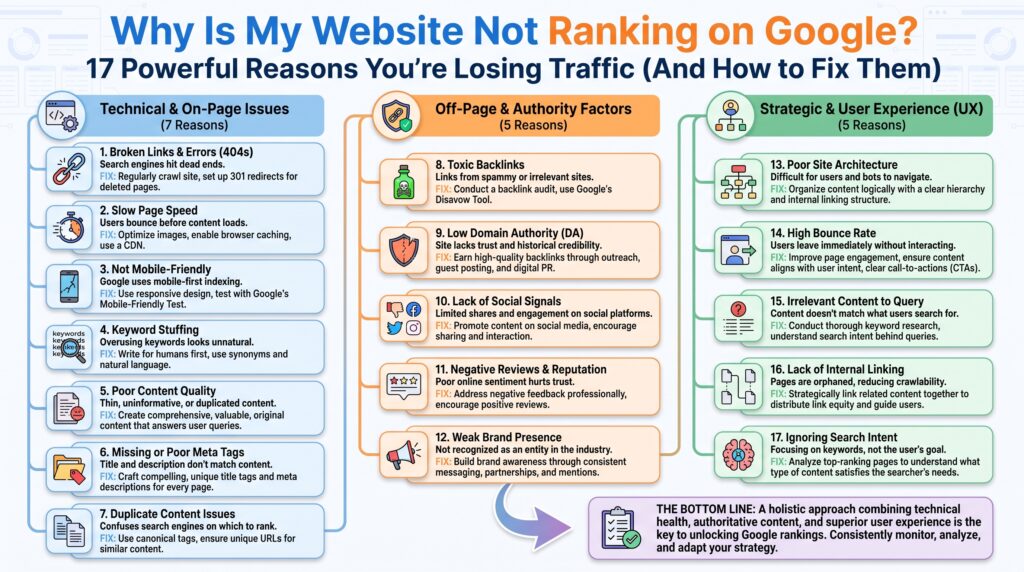
Why Is My Website Not Ranking on Google?
If you’ve been asking yourself, why is my website not ranking on Google, you’re certainly not alone. Thousands of website owners, bloggers, and business owners invest countless hours creating content, optimizing pages, and building websites—only to see little or no organic traffic. It can be frustrating when competitors appear above you despite offering similar products or services.
The good news is that Google rankings aren’t random. Search visibility depends on hundreds of ranking signals, many of which are completely within your control. Whether your website is brand new, has experienced a sudden traffic drop, or simply struggles to climb the search results, understanding why is my website not ranking on Google is the first step toward fixing the problem.
This guide explores the most common reasons websites fail to rank and provides practical, expert-backed strategies to improve visibility. You’ll also learn how Google’s ranking systems evaluate websites, what mistakes to avoid, and how to build a long-term SEO strategy that delivers sustainable growth.
“Focus on creating helpful, reliable, people-first content rather than chasing search engine algorithms.”
That advice closely reflects Google’s long-standing guidance for website owners and remains one of the most valuable SEO principles today.
Understanding How Google Decides Rankings
Before solving why is my website not ranking on Google, it’s important to understand how Google actually ranks web pages.
Google’s search engine works through three primary processes:
- Crawling
- Indexing
- Ranking
First, Google discovers pages through links and XML sitemaps. Then it analyzes and stores those pages in its index. Finally, Google’s algorithms determine where each page should appear based on hundreds of ranking factors.
These factors include:
- Content quality
- Search intent
- Page experience
- Website authority
- Backlinks
- Internal linking
- User engagement
- Technical SEO
- Freshness
- Mobile usability
If any of these areas have significant weaknesses, your answer to why is my website not ranking on Google often becomes much clearer.
Your Website May Not Even Be Indexed
One surprisingly common reason behind why is my website not ranking on Google is that Google hasn’t indexed your pages yet.
Many website owners assume publishing automatically means ranking. Unfortunately, that’s not true.
Sometimes Google hasn’t discovered your content because:
- Your sitemap wasn’t submitted.
- Your robots.txt blocks crawlers.
- Important pages contain a “noindex” tag.
- Internal linking is poor.
- Your website is too new.
Always search:
site:yourdomain.com
If your pages don’t appear, Google hasn’t indexed them.
The solution involves submitting your sitemap through Google Search Console, checking indexing reports, fixing crawl issues, and ensuring important pages are accessible.
Your Website Is Too New
Another major answer to why is my website not ranking on Google is simple: your website hasn’t built enough trust yet.
Google evaluates domains over time.
Brand-new websites rarely dominate competitive keywords because they lack:
- Authority
- Backlinks
- Historical performance
- User engagement signals
Think of SEO like building a professional reputation. Even if you’re highly skilled, people need time before recommending you.
Many new websites begin seeing noticeable ranking improvements after several months of publishing consistent, high-quality content.
Patience is an underrated SEO strategy.
You’re Targeting Extremely Competitive Keywords
Many businesses unknowingly compete against websites with years of authority.
Imagine launching a small local bakery and trying to outrank major national brands overnight.
That’s exactly what happens when targeting keywords with enormous competition.
Instead of only focusing on broad keywords, target long-tail search phrases such as:
- why is my website not ranking on Google after indexing
- why is my website not ranking on Google despite SEO
- website not appearing in Google search results
- Google ranking issues for small business websites
- improve website ranking on Google organically
These keywords often have:
- Lower competition
- Higher conversion rates
- Better search intent
- Faster ranking opportunities
This strategy creates momentum before pursuing broader search terms.
Your Content Doesn’t Match Search Intent
Google’s biggest priority is satisfying users.
That’s why understanding search intent is critical when solving why is my website not ranking on Google.
Search intent generally falls into four categories:
- Informational
- Navigational
- Commercial
- Transactional
Someone searching why is my website not ranking on Google wants practical explanations and actionable solutions—not a sales page promoting SEO services.
If your content doesn’t answer the user’s question clearly, Google will prioritize pages that do.
Before publishing any article, ask yourself:
“Does this page fully answer the exact question someone typed into Google?”
If the answer isn’t a confident yes, improvements are needed.
Your Content Isn’t Comprehensive Enough
Google increasingly rewards pages demonstrating topical authority.
Thin content often struggles because it leaves readers with unanswered questions.
Strong SEO articles usually include:
- Clear explanations
- Real examples
- Practical solutions
- Supporting evidence
- Related questions
- Updated information
Suppose someone searches why is my website not ranking on Google.
A 500-word article listing five generic tips rarely satisfies users.
A detailed guide explaining technical SEO, content optimization, indexing, backlinks, Core Web Vitals, keyword strategy, and Google Search Console provides significantly more value.
Comprehensive content naturally keeps visitors engaged longer.
Poor On-Page SEO Is Limiting Your Rankings
Even excellent content needs proper optimization.
Many websites asking why is my website not ranking on Google overlook basic on-page SEO elements.
Review these areas carefully:
- SEO title
- Meta description
- Heading structure
- URL optimization
- Image alt text
- Internal linking
- Keyword placement
- Semantic keywords
- Readability
Avoid stuffing your focus keyword into every sentence.
Instead, naturally combine related phrases such as:
- Google search rankings
- organic traffic
- search visibility
- search engine optimization
- keyword optimization
- website SEO
- ranking factors
- Google algorithm
- search performance
- technical optimization
This creates semantic relevance without appearing spammy.
Your Website Loads Too Slowly
Website speed directly affects user experience.
Visitors quickly leave websites that take too long to load.
Google notices these behaviors.
Common speed issues include:
- Large images
- Unoptimized JavaScript
- Excessive plugins
- Slow hosting
- Poor caching
- Heavy page builders
Imagine clicking a search result and waiting ten seconds before seeing anything.
Most users simply leave.
Improving website speed often leads to better engagement, lower bounce rates, and stronger rankings over time.
Mobile Optimization Is No Longer Optional
Google primarily evaluates websites using mobile-first indexing.
That means Google examines your mobile website before your desktop version.
If your mobile experience is poor, it may explain why is my website not ranking on Google.
Common mobile problems include:
- Tiny text
- Buttons too close together
- Horizontal scrolling
- Slow mobile speed
- Intrusive pop-ups
- Broken layouts
Today’s users expect fast, responsive websites on every device.
Delivering an excellent mobile experience builds trust with both users and search engines.
Your Internal Linking Strategy Is Weak
Internal links are often overlooked despite being one of the easiest SEO improvements.
Good internal linking helps Google:
- Discover pages
- Understand relationships
- Pass authority
- Improve crawling
- Keep visitors engaged
For example, an article discussing why is my website not ranking on Google should naturally connect to related topics like:
- Technical SEO
- Keyword research
- Content marketing
- Website audits
- Google Search Console
- Page speed optimization
This creates a logical content ecosystem instead of isolated pages competing independently.
A strong internal linking strategy also encourages readers to explore additional content, increasing session duration and reinforcing your site’s topical authority.
Building High-Quality Backlinks Takes Time
Another major reason behind why is my website not ranking on Google is a lack of quality backlinks.
Backlinks remain one of Google’s strongest ranking signals because they act as votes of confidence from other websites. However, not all links are equal. A handful of links from reputable, relevant websites often carry more value than hundreds of low-quality links.
Consider two websites publishing similar content. One has earned backlinks from respected industry blogs, while the other has no external references. Google is far more likely to trust the first website because others have effectively endorsed its content.
Instead of buying backlinks or participating in link schemes, focus on earning links naturally through outstanding resources, original research, guest posting, digital PR, and shareable content.
Technical SEO Problems Are Holding You Back
If you’ve optimized your content but still wonder why is my website not ranking on Google, technical SEO deserves close attention.
Even excellent content can struggle if search engines encounter technical issues.
Common problems include:
- Broken links (404 errors)
- Redirect chains
- Duplicate content
- Missing canonical tags
- Poor XML sitemap configuration
- Crawl errors
- HTTPS issues
- JavaScript rendering problems
Conducting regular SEO audits helps identify these hidden obstacles before they negatively affect rankings.
Your Website Lacks Topical Authority
Google increasingly rewards websites that demonstrate expertise across an entire subject rather than isolated articles.
For example, instead of publishing only one article answering why is my website not ranking on Google, build a complete content hub covering related topics such as:
- Keyword research
- Technical SEO
- On-page optimization
- Link building
- Google Search Console
- Local SEO
- Content marketing
- Core Web Vitals
When these articles are internally linked, Google gains stronger confidence that your website is a reliable resource on SEO.
This approach strengthens your overall topical authority and improves the ranking potential of every related page.
User Experience Influences Rankings
SEO isn’t just about pleasing search engines—it starts with serving people.
Google evaluates signals that reflect user satisfaction, including:
- Easy navigation
- Readable formatting
- Fast loading times
- Mobile responsiveness
- Helpful content
- Clear calls to action
Imagine landing on a page filled with intrusive ads, confusing menus, and dense paragraphs. Most visitors leave within seconds.
A clean, intuitive website encourages longer visits, more page views, and better engagement—all of which support stronger search performance.
Mini Case Study: A Small Business Turnaround
A U.S.-based home services company struggled with why is my website not ranking on Google despite publishing regular blog posts.
An SEO audit uncovered several issues:
- Thin content
- Duplicate title tags
- Slow page speed
- Weak internal linking
- Very few backlinks
Over six months, the company:
- Expanded existing articles with detailed, user-focused information.
- Improved page speed by compressing images and optimizing code.
- Built internal links between related content.
- Earned backlinks through local partnerships and guest articles.
- Updated outdated pages with fresh information.
The result was a steady increase in indexed pages, improved keyword rankings, and significantly more organic traffic. While every website is different, this example highlights how consistent improvements across multiple SEO areas often outperform quick fixes.
Content Freshness Matters
Search engines favor content that remains accurate and useful.
If your article answering why is my website not ranking on Google hasn’t been updated in years, competitors with fresher information may overtake it.
Refresh older content by:
- Updating statistics
- Adding recent examples
- Improving readability
- Expanding sections
- Including new FAQs
- Fixing outdated screenshots or references
Regular updates signal that your content remains relevant.
Build Trust Through E-E-A-T
Google values content demonstrating Experience, Expertise, Authoritativeness, and Trustworthiness (E-E-A-T).
Strengthen these signals by:
- Publishing accurate information.
- Citing reputable research and industry guidance.
- Including real-world examples.
- Displaying clear author information.
- Maintaining transparent contact and privacy pages.
- Keeping your website secure with HTTPS.
Insights inspired by academic information retrieval research and search quality guidance consistently show that trustworthy, well-supported content performs better over time than thin, keyword-focused pages.
“SEO success comes from consistently delivering the best answer to the user’s question—not simply targeting keywords.”
Monitor Performance Instead of Guessing
Many website owners continuously ask why is my website not ranking on Google without examining actual performance data.
Use tools such as:
- Google Search Console
- Google Analytics
- PageSpeed Insights
- SEO auditing platforms
Monitor:
- Click-through rate (CTR)
- Impressions
- Indexed pages
- Crawl errors
- Core Web Vitals
- Organic traffic
- Average keyword positions
Data-driven decisions consistently outperform assumptions.
Create a Long-Term SEO Strategy
SEO is a marathon rather than a sprint.
Successful websites generally follow a sustainable strategy:
- Publish helpful content consistently.
- Optimize existing pages.
- Improve technical SEO.
- Build authoritative backlinks.
- Strengthen internal linking.
- Monitor performance regularly.
- Update older articles.
Small, continuous improvements compound over time and lead to lasting search visibility.
Frequently Asked Questions
Why is my website not ranking on Google even after indexing?
Indexing only means Google knows your page exists. Rankings depend on content quality, relevance, authority, backlinks, technical SEO, and user experience.
How long does it take for a website to rank on Google?
For newer websites, noticeable improvements often take several months. Highly competitive keywords can require significantly longer, depending on your niche and SEO efforts.
Can poor website speed affect Google rankings?
Yes. Slow-loading pages create a poor user experience and may reduce engagement, making speed optimization an important part of SEO.
Does duplicate content hurt rankings?
Duplicate or substantially similar content can confuse search engines and dilute ranking signals. Creating unique, valuable pages is the better approach.
Do backlinks still matter in SEO?
Absolutely. High-quality backlinks from relevant, trustworthy websites remain an important ranking factor and help establish authority.
What’s the fastest way to improve my Google rankings?
There isn’t a single fast solution. Focus on fixing technical issues, improving content quality, matching search intent, optimizing on-page SEO, and earning authoritative backlinks.
Conclusion
If you’ve been wondering why is my website not ranking on Google, remember that the answer is rarely just one issue. Rankings are influenced by a combination of content quality, search intent, technical SEO, website authority, user experience, backlinks, and consistent optimization.
Instead of chasing shortcuts or algorithm myths, invest in creating genuinely helpful content, maintaining a technically sound website, and earning trust over time. Search engine optimization rewards consistency, patience, and a user-first approach.
By applying the strategies outlined in this guide, you’ll be better positioned to improve search visibility, attract qualified organic traffic, and build sustainable rankings that last. Start with one improvement today, measure your progress, and continue refining your SEO strategy as your website grows.