If you’ve ever wondered what is SEO marketing, you’re not alone. Millions of business owners, bloggers, and marketers ask this question every year because search engine optimization remains one of the most effective ways to attract qualified visitors online. Unlike paid advertising, SEO delivers long-term visibility by helping your website appear in search results when people actively search for information, products, or services.
Understanding what is SEO marketing is no longer optional for businesses that want to compete online. Whether you run a local company, an eCommerce store, a SaaS startup, or a personal blog, SEO helps you connect with your ideal audience at the exact moment they’re searching. Throughout this guide, you’ll learn how SEO works, why it matters, the strategies professionals use, and how you can build a successful SEO campaign that continues delivering results for years.
What Is SEO Marketing and Why Does It Matter?
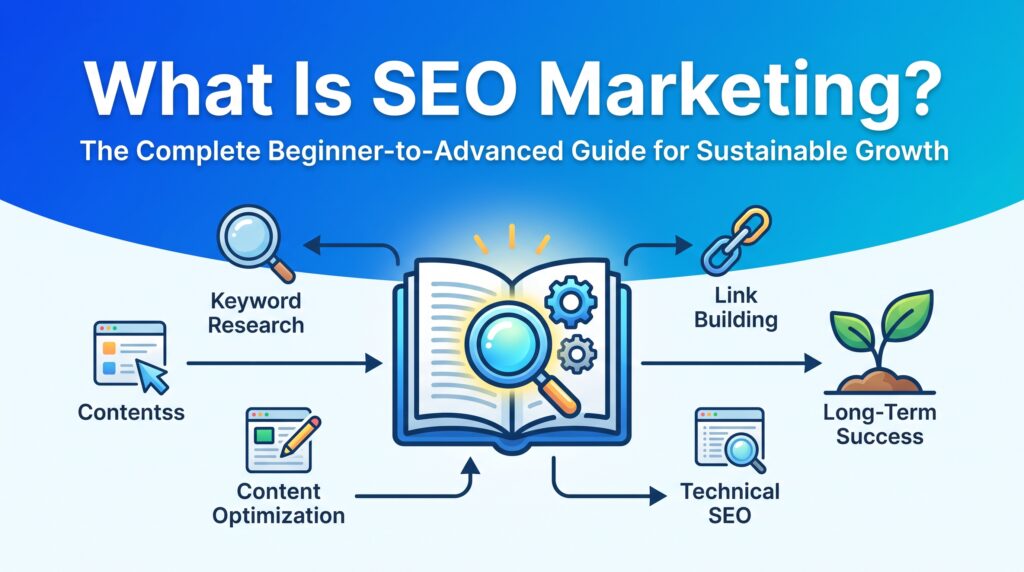
Simply put, what is SEO marketing refers to the process of optimizing your website so search engines like Google can better understand, index, and rank your content for relevant searches. SEO marketing combines technical improvements, high-quality content, keyword optimization, user experience, and authority-building to increase organic traffic.
Instead of paying for every visitor through advertising, SEO focuses on earning visibility naturally. When your pages rank well, potential customers find your business while searching for answers, products, or services.
Today’s consumers trust organic search results because they often perceive them as more credible than advertisements. Businesses that invest in SEO frequently enjoy consistent traffic, stronger brand awareness, higher customer trust, and improved return on investment.
SEO marketing also supports nearly every stage of the customer journey—from discovering a problem to comparing solutions and making purchasing decisions.
How Search Engines Actually Work
To truly understand what is SEO marketing, you first need to understand how search engines operate.
Google follows three primary steps before displaying your website in search results.
Crawling
Search engine bots continuously discover new webpages by following internal and external links. They scan billions of pages across the internet every day.
Indexing
After crawling a webpage, Google analyzes its content, images, structure, metadata, and relevance before storing it in its massive search index.
Ranking
Whenever someone performs a search, Google’s algorithms evaluate hundreds of ranking signals to determine which pages deserve the highest positions.
These signals include:
- Content relevance
- Search intent
- Website authority
- User experience
- Mobile friendliness
- Page speed
- Content freshness
- Backlink quality
- HTTPS security
- Internal linking
The better your website satisfies these factors, the greater your chances of ranking highly.
The Core Components of SEO Marketing
Learning what is SEO marketing becomes much easier when you break it into its major components.
On-Page SEO
On-page SEO includes everything you optimize directly on your website.
Examples include:
- Keyword placement
- Title tags
- Meta descriptions
- Header structure
- Image optimization
- Internal linking
- Readability
- Content quality
Each page should focus on one primary topic while naturally incorporating related keywords and semantic variations.
Technical SEO
Technical SEO ensures search engines can easily crawl and understand your website.
Important elements include:
- Fast loading speed
- XML sitemaps
- Robots.txt optimization
- Structured data
- Canonical tags
- Mobile responsiveness
- HTTPS encryption
- Core Web Vitals
- Clean URL structure
A technically healthy website creates a stronger foundation for every other SEO effort.
Off-Page SEO
Off-page SEO focuses on building your site’s authority across the web.
This often involves:
- High-quality backlinks
- Digital PR
- Guest blogging
- Brand mentions
- Local citations
- Social visibility
When reputable websites link to your content, search engines interpret those links as signals of trust and credibility.
Local SEO
For businesses serving specific geographic areas, local SEO is essential.
Optimizing for Google Business Profile, customer reviews, local keywords, citations, and location pages helps businesses appear in local search results and Google Maps.
Why SEO Marketing Is Better Than Short-Term Advertising
Many businesses compare SEO with pay-per-click advertising (PPC).
Paid advertising produces immediate traffic but stops generating visitors once your budget runs out.
SEO, on the other hand, continues delivering qualified traffic long after your content has been published.
Imagine two businesses selling identical products.
Company A spends thousands every month on ads.
Company B invests in content, technical optimization, and authority-building.
Initially, Company A may receive faster traffic. However, after twelve months, Company B often earns consistent organic visitors without paying for every click.
This long-term value explains why SEO remains one of the highest ROI digital marketing channels.
The Benefits of SEO Marketing for Businesses
Understanding what is SEO marketing also means recognizing its long-term business value.
SEO offers advantages that extend beyond rankings.
Increased Organic Traffic
Higher rankings naturally generate more website visitors from users already interested in your products or services.
Unlike random advertising impressions, SEO attracts people actively searching for solutions.
Better User Experience
Modern SEO emphasizes user satisfaction.
Improving navigation, loading speed, mobile usability, and content quality not only helps rankings but also increases engagement and conversions.
Higher Credibility
Users generally trust websites that appear near the top of Google’s organic results.
Consistently publishing helpful content builds authority within your industry.
Cost-Effective Marketing
While SEO requires investment, its long-term cost per acquisition is often significantly lower than paid advertising.
Quality content can continue generating traffic for years.
Stronger Brand Awareness
Every appearance in search results reinforces your brand.
Even if users don’t click immediately, repeated exposure increases familiarity and trust.
Understanding Search Intent
One of the biggest mistakes beginners make when learning what is SEO marketing is focusing only on keywords.
Modern SEO revolves around search intent.
Google wants to satisfy users—not simply match keywords.
There are four primary types of search intent.
Informational
Users want answers.
Examples include:
- What is SEO marketing
- How does SEO work
- SEO guide for beginners
Navigational
Users already know where they want to go.
Examples include:
- Google Search Console
- YouTube Studio
- Gmail login
Commercial Investigation
Users compare options before buying.
Examples include:
- Best SEO tools
- Top SEO agencies
- SEO software reviews
Transactional
Users are ready to purchase.
Examples include:
- Hire SEO consultant
- Buy SEO software
- SEO services near me
Matching your content to search intent dramatically improves ranking potential.
Keyword Research: The Foundation of SEO Marketing
Every successful SEO campaign begins with keyword research.
When studying what is SEO marketing, you’ll quickly discover that choosing the right keywords determines whether your content reaches the right audience.
Professional SEO specialists don’t simply choose popular keywords.
They evaluate:
- Search volume
- Keyword difficulty
- User intent
- Competition
- Business relevance
- Conversion potential
Long-tail keywords often produce better conversion rates because they’re more specific.
For example:
Instead of targeting:
“SEO”
You could target:
- what is seo marketing
- what is seo marketing for beginners
- how SEO marketing works
- SEO marketing strategy
- SEO marketing examples
These phrases attract users with clearer intent and often face less competition.
Creating Content That Google Loves
High-quality content remains the heart of SEO.
Google’s Helpful Content System rewards pages that genuinely solve readers’ problems rather than simply targeting keywords.
Effective SEO content should:
- Answer questions thoroughly
- Provide original insights
- Demonstrate expertise
- Include real examples
- Stay updated
- Be easy to read
- Use clear headings
- Include trustworthy references
Rather than writing for search engines alone, successful marketers create content primarily for people.
That approach naturally aligns with Google’s evolving algorithms.
Experience, Expertise, Authority, and Trust Matter
Google increasingly rewards websites demonstrating strong Experience, Expertise, Authority, and Trustworthiness (E-E-A-T).
For example, an experienced SEO consultant explaining technical optimization from years of real-world campaigns offers greater value than AI-generated content lacking practical insights.
“SEO is not about gaming search engines—it is about creating the best possible experience for users while helping search engines understand your content.”
This philosophy aligns with guidance consistently promoted by experienced search professionals and research emphasizing relevance, quality, and user satisfaction.
A Mini Case Study: How SEO Changed a Small Business
Consider a small home remodeling company struggling to attract leads.
Instead of relying solely on paid advertisements, the business invested in publishing educational articles, improving page speed, optimizing service pages, and earning backlinks from reputable industry websites.
Within several months, organic traffic increased significantly. More importantly, inquiries from homeowners searching for renovation services became more consistent because the company appeared for highly relevant local searches.
This example illustrates that understanding what is SEO marketing is about more than rankings—it’s about creating a sustainable system that connects businesses with customers actively looking for their expertise.
Common SEO Marketing Mistakes to Avoid
Even after understanding what is SEO marketing, many website owners make mistakes that limit their rankings. Avoiding these common issues can save months of frustration and help your SEO efforts produce better results.
Ignoring Search Intent
Many businesses focus only on inserting keywords instead of answering the user’s actual question. Google rewards pages that completely satisfy search intent. If someone searches what is SEO marketing, they expect a clear explanation, practical examples, and actionable advice—not a sales pitch.
Keyword Stuffing
Years ago, repeating a keyword excessively could improve rankings. Today, keyword stuffing harms readability and may negatively affect performance.
Instead, use what is SEO marketing naturally while incorporating related phrases like:
- SEO strategy
- Organic search optimization
- Search engine optimization
- Digital marketing SEO
- Google ranking factors
- Organic traffic
- Website optimization
This creates content that feels natural while helping search engines understand the topic.
Publishing Thin Content
Short, generic articles rarely outperform comprehensive resources. Google’s algorithms favor content that demonstrates depth, expertise, and usefulness.
Whenever you create a page, ask yourself:
- Does it fully answer the user’s question?
- Does it offer unique insights?
- Would someone bookmark or share it?
If the answer is yes, you’re moving in the right direction.
How SEO Marketing Fits Into Your Overall Digital Marketing Strategy
Many beginners assume SEO works independently, but successful businesses integrate it with their broader marketing efforts.
Content marketing provides valuable resources that attract visitors through organic search.
Social media helps amplify content, increasing visibility and encouraging natural backlinks.
Email marketing nurtures visitors who discover your website through SEO, turning readers into loyal customers.
Paid advertising can complement SEO by generating immediate traffic while your organic rankings grow over time.
Together, these channels create a comprehensive digital marketing ecosystem that supports long-term business growth.
Essential SEO Tools Every Beginner Should Know
Understanding what is SEO marketing becomes much easier when you use the right tools. While expertise matters more than software, these platforms simplify research, tracking, and optimization.
Google Search Console
Google Search Console helps you monitor search performance, identify indexing issues, and discover which keywords drive traffic to your website.
Google Analytics
Analytics provides valuable insights into visitor behavior, engagement, conversions, and traffic sources.
Keyword Research Tools
Platforms such as Ahrefs, Semrush, Moz, and Keyword Planner help identify search volume, competition, and keyword opportunities.
Technical SEO Crawlers
Site auditing tools uncover broken links, duplicate content, missing metadata, crawl errors, and other technical issues that affect rankings.
Using data from these tools enables smarter SEO decisions rather than relying on guesswork.
SEO Trends Shaping the Future
The answer to what is SEO marketing continues evolving as search technology advances.
Artificial intelligence is transforming how search engines understand language, context, and user intent. Google’s algorithms increasingly prioritize helpful, people-first content over pages created solely for rankings.
Voice search continues growing as consumers use smart speakers and mobile assistants.
Visual search is becoming more sophisticated, allowing users to search with images instead of text.
Mobile-first indexing remains essential because most searches now occur on smartphones.
Core Web Vitals continue emphasizing page speed, responsiveness, and visual stability.
Businesses that stay informed about these trends position themselves for long-term success.
How to Build an Effective SEO Marketing Strategy
A successful SEO strategy doesn’t happen overnight. It requires planning, consistency, and ongoing optimization.
Begin by defining your target audience. Understand their problems, questions, and search behavior.
Conduct comprehensive keyword research to identify topics your audience cares about.
Create high-quality content that answers those questions better than competing websites.
Optimize every page with descriptive titles, compelling meta descriptions, logical headings, internal links, and relevant images.
Improve technical performance by ensuring your website loads quickly, works well on mobile devices, and is easy for search engines to crawl.
Build authority through ethical backlink acquisition, partnerships, and valuable content worthy of citations.
Finally, measure your results regularly and refine your strategy based on real performance data.
SEO is an ongoing process—not a one-time project.
Why Patience Is Essential in SEO Marketing
One of the biggest misconceptions about what is SEO marketing is expecting immediate results.
Unlike paid advertising, SEO requires time. Search engines need to crawl, index, and evaluate your content before rankings improve.
Depending on competition, website authority, and content quality, noticeable improvements may take several months.
However, the long-term benefits often outweigh the initial waiting period. A well-optimized article can continue attracting qualified visitors years after publication, making SEO one of the most sustainable digital marketing investments available.
Frequently Asked Questions
What is SEO marketing in simple words?
What is SEO marketing is the process of improving your website so it appears higher in search engine results, helping attract free, relevant visitors organically.
How long does SEO marketing take to show results?
Most websites begin seeing measurable improvements within three to six months, although highly competitive industries may require more time.
Is SEO marketing better than paid advertising?
Both have advantages. Paid advertising delivers immediate traffic, while SEO provides long-term, sustainable organic visibility. Many successful businesses use both together.
Can beginners learn SEO marketing?
Yes. With consistent learning, practical experience, and reliable resources, beginners can understand what is SEO marketing and implement effective optimization strategies.
Why is content important in SEO marketing?
Content helps search engines understand your website while providing valuable information that satisfies user intent, builds authority, and encourages backlinks.
Does SEO marketing still work in 2026?
Absolutely. Although algorithms continue evolving, businesses that create helpful, authoritative, and user-focused content consistently benefit from SEO.
Conclusion
By now, you should have a clear understanding of what is SEO marketing and why it remains one of the most valuable digital marketing strategies available. SEO is far more than simply ranking for keywords—it’s about creating exceptional content, delivering outstanding user experiences, building trust, and helping search engines connect your website with the right audience.
Whether you’re a small business owner, entrepreneur, blogger, or marketing professional, investing in SEO can generate sustainable traffic, increase brand visibility, and drive meaningful business growth. The most successful websites don’t chase shortcuts; they consistently publish valuable content, optimize their technical foundations, and earn authority over time.
If you’re ready to improve your online presence, start by applying the principles covered in this guide. Focus on your audience, create genuinely helpful content, and continuously refine your strategy. Over time, your efforts can translate into stronger rankings, increased organic traffic, and lasting success.