Choosing the right SEO packages can make the difference between a website that quietly sits on page five of Google and one that consistently attracts qualified organic traffic. But with agencies offering monthly plans, local SEO packages, technical SEO services, enterprise solutions, and customized campaigns, knowing what you actually need can be confusing.
The good news is that SEO does not have to be mysterious. A strong SEO package should connect technical optimization, keyword research, quality content, authority building, local visibility, and measurable performance to your business goals. This guide explains what SEO packages include, how much they typically cost, which type is right for your business, what to watch out for, and how to evaluate an SEO provider before signing a contract.
What Are SEO Packages?
SEO packages are predefined or customized bundles of search engine optimization services offered by an SEO agency, consultant, or digital marketing company. Instead of purchasing every SEO service separately, businesses typically pay a monthly or project-based fee for a collection of activities designed to improve organic search visibility.
A typical package may include SEO audits, keyword research, on-page optimization, technical SEO, content creation, link building, local SEO, competitor analysis, reporting, and performance monitoring.
However, not all packages are created equally. One provider may focus heavily on content, while another specializes in technical SEO or local search. The quality of strategy, implementation, expertise, and reporting can matter far more than the number of services listed on a pricing page.
For example, a local plumber in Texas does not necessarily need the same strategy as a national e-commerce company selling products across the United States. Their search markets, competitors, customer journeys, keywords, and conversion goals are completely different.
That is why the best SEO packages are aligned with the website’s size, industry, competition, geographic targeting, and business objectives.
Why Do Businesses Invest in SEO Packages?
Organic search can become one of the most valuable long-term acquisition channels for a business. Unlike paid advertising, where traffic generally stops when spending stops, successful SEO can continue generating visibility after individual optimizations and content assets have been published.
SEO can help businesses:
- Increase organic website traffic
- Improve rankings for commercially valuable keywords
- Generate qualified leads
- Increase online visibility
- Strengthen brand authority
- Improve website usability
- Capture local customers
- Support e-commerce sales
- Reduce dependence on paid advertising
Consider a hypothetical SaaS company targeting the keyword “project management software for small business.” If its page moves from the bottom of page two into the top results, the increase in qualified visitors could have significant commercial value.
But rankings alone are not the objective. Traffic needs to reach the right pages, attract the right audience, and contribute to conversions.
That distinction separates strategic SEO from superficial optimization.
What Do SEO Packages Usually Include?
The exact deliverables vary, but high-quality SEO packages generally combine several fundamental areas of optimization.
SEO Audit and Website Analysis
An SEO campaign usually starts with an assessment of the website.
An audit can identify technical errors, indexing problems, duplicate content, broken links, slow pages, weak internal linking, poor metadata, mobile usability issues, and other potential obstacles.
A professional audit should also examine competitors and the current search landscape rather than simply producing a generic checklist.
Keyword Research
Keyword research determines what potential customers are searching for and how those searches relate to the company’s products or services.
Modern keyword research goes beyond finding high-volume phrases. SEO professionals examine:
Search intent, relevance, competition, commercial value, topical relationships, and the stage of the buyer journey.
For example, “what is CRM software” indicates a different intent from “best CRM software for startups” or “buy CRM software.”
A good strategy creates content that addresses these different intents instead of attempting to rank one page for everything.
On-Page SEO
On-page optimization focuses on elements that can be improved directly on a webpage.
This may include title tags, meta descriptions, headings, URL structure, content organization, internal links, image optimization, semantic relevance, and user experience.
The objective is not to repeatedly insert a keyword. Modern optimization focuses on clearly demonstrating that a page comprehensively satisfies the searcher’s needs.
Technical SEO
Technical SEO addresses how search engines crawl, interpret, and index a website.
Depending on the website, technical work may include:
- Crawlability improvements
- Indexation management
- XML sitemap optimization
- Canonicalization
- Structured data
- Core Web Vitals
- Mobile performance
- Redirect management
- JavaScript SEO
- HTTPS configuration
- Duplicate-content management
- Site architecture
Technical SEO becomes especially important for large websites with thousands or millions of URLs.
Content Strategy and Content Creation
Content remains an important component of many SEO packages, but publishing large quantities of generic articles is not a sustainable strategy.
Effective SEO content should demonstrate relevance, expertise, usefulness, and originality.
A content strategy might include educational guides, comparison pages, service pages, product pages, original research, case studies, FAQs, and supporting topical content.
For example, a financial software company might create a topic cluster around small-business accounting, including guides about bookkeeping, tax preparation, invoicing, payroll, and accounting software.
The pages can then support one another through strategic internal linking.
Link Building and Digital Authority
Links from relevant and trustworthy websites can contribute to a site’s authority and discoverability.
However, quality matters considerably more than simply accumulating links.
A professional SEO strategy may use digital PR, expert contributions, original research, useful resources, partnerships, editorial outreach, and other legitimate approaches to earning relevant mentions.
Businesses should be cautious about providers promising hundreds or thousands of backlinks every month without explaining where those links come from.
Local SEO
Local SEO is particularly valuable for businesses serving specific geographic areas.
Local-focused SEO packages may include Google Business Profile optimization, local keyword research, location pages, citation management, review strategy, local content, and reputation development.
Imagine a dental practice competing for searches such as “dentist near me” and “family dentist in Austin.” Its strategy should be substantially different from an online retailer serving customers nationwide.
Reporting and Analytics
Transparent reporting is one of the most important parts of an SEO campaign.
A useful report should connect SEO activity with meaningful outcomes.
Depending on the business, useful metrics may include:
Organic traffic, rankings, impressions, clicks, conversions, leads, revenue, indexed pages, engagement, and visibility across important search queries.
A report containing dozens of numbers is not necessarily a good report. The best reporting explains what happened, why it happened, what was changed, and what happens next.
Types of SEO Packages
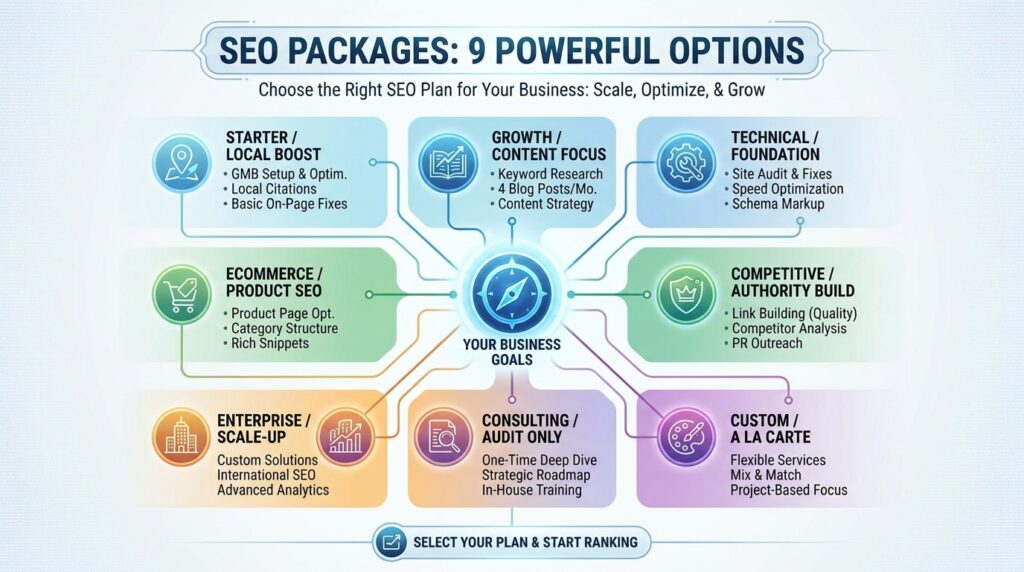
There is no universal package that works for every business. The following categories can help you understand the most common options.
Local SEO Packages
Local SEO packages are designed for businesses that depend on customers in specific cities, regions, or service areas.
Typical customers include restaurants, contractors, medical practices, law firms, real estate companies, salons, and professional services.
The strategy generally emphasizes local search visibility, Google Business Profile optimization, reviews, location relevance, citations, and locally targeted pages.
Small Business SEO Packages
Small businesses often need a balanced strategy that prioritizes high-impact improvements without the cost of an enterprise campaign.
A small-business plan might combine technical fixes, keyword research, content optimization, local SEO, link acquisition, and monthly reporting.
The key is prioritization. A smaller website may benefit more from improving 10 important pages than publishing 50 low-quality articles.
E-Commerce SEO Packages
E-commerce SEO requires attention to product pages, category pages, faceted navigation, internal linking, structured data, crawl management, and commercial search intent.
An online store selling thousands of products may face technical challenges that a 20-page service business never encounters.
Strong e-commerce SEO also considers product availability, user experience, reviews, product information, and conversion optimization.
Enterprise SEO Packages
Enterprise websites require sophisticated SEO strategies because they often contain enormous numbers of pages and involve multiple teams.
Enterprise SEO packages may include large-scale technical SEO, international SEO, automation, content governance, advanced analytics, migration support, and coordination with developers.
At this level, even a small technical problem can affect thousands of URLs.
National SEO Packages
National SEO targets customers across an entire country rather than a specific local market.
This can be highly competitive, particularly for industries such as insurance, finance, software, healthcare, travel, and e-commerce.
National campaigns typically require substantial content development, authority building, technical optimization, and competitive analysis.
Customized SEO Packages
Customized plans are often the most appropriate option when a business has unusual requirements.
A customized package might combine local SEO with content marketing, technical SEO, international targeting, e-commerce optimization, or digital PR.
Instead of buying every available service, the business pays for work that directly supports its objectives.
How Much Do SEO Packages Cost?
The cost of SEO packages varies dramatically depending on the provider, market, website size, competition, and scope of work.
For the U.S. market, businesses may encounter monthly plans ranging from several hundred dollars for limited local work to several thousand dollars or considerably more for competitive national or enterprise campaigns.
There is no single “correct” SEO price.
A $500 monthly plan may be reasonable for a small local business with limited competition. The same budget would be unrealistic for a national e-commerce company competing against major established brands.
When comparing prices, evaluate what is actually being delivered rather than choosing the cheapest package.
Ask:
- How many pages will be optimized?
- How much content is included?
- Who creates the content?
- What technical work is included?
- How is link acquisition handled?
- Is local SEO included?
- How frequently are strategies reviewed?
- What reporting is provided?
- Who manages the campaign?
- Are there setup fees?
- Is there a contract period?
Price should be evaluated alongside expected business value.
How to Choose the Right SEO Package
The right SEO packages should reflect your business model rather than simply your budget.
Start by defining your primary objective.
Are you trying to generate local leads? Increase online sales? Build national visibility? Recover from a traffic decline? Launch a new website? Expand into new markets?
Once the objective is clear, determine which SEO activities are most likely to influence it.
For example, a local HVAC company might prioritize Google Business Profile optimization and location-based service pages, while a national SaaS company might prioritize technical SEO, topic clusters, comparison content, and digital authority.
Examine the Deliverables
Avoid vague promises such as “complete SEO” without details.
A trustworthy provider should be able to explain what happens during the first 30, 60, and 90 days.
The proposal should clarify deliverables, responsibilities, timelines, reporting, and strategic priorities.
Evaluate Experience
Ask whether the provider has worked with businesses similar to yours.
Relevant experience does not guarantee results, but it can reduce the learning curve and help an SEO professional understand industry-specific search behavior.
Look for Transparent Reporting
A reputable provider should be willing to explain both positive and negative developments.
SEO involves uncertainty. Search algorithms change, competitors publish new content, websites undergo technical changes, and rankings fluctuate.
Anyone guaranteeing a specific Google ranking should be approached cautiously.
Check Case Studies Carefully
Case studies can provide useful evidence, but look beyond impressive traffic percentages.
Ask:
What was the starting point? Which keywords improved? Did conversions increase? Over what timeframe? What actions produced the improvement?
A 300% traffic increase sounds impressive until you discover that the website went from 10 monthly visitors to 40.
Context matters.
Red Flags to Watch for When Buying SEO Packages
Some offers look attractive because they promise huge quantities at extremely low prices.
Be cautious of providers promising:
Guaranteed #1 Google rankings, thousands of backlinks, instant results, secret algorithms, or massive traffic increases within a few weeks.
Search engines do not provide legitimate SEO companies with a private shortcut to guaranteed rankings.
Another warning sign is a package that focuses entirely on keyword density.
Repeating a keyword dozens of times does not automatically make content more useful or authoritative.
Similarly, automated content produced at scale without meaningful editorial oversight can create pages that fail to satisfy users.
The strongest SEO packages emphasize sustainable optimization rather than shortcuts.
A Mini Case Study: Improving a Local Service Website
Consider a fictional home-remodeling company with a website receiving approximately 1,000 organic visits per month.
An initial audit discovers that its service pages target broad keywords but contain little location-specific information. The site also has weak internal linking and several pages competing for similar terms.
Instead of publishing dozens of new articles, the SEO team restructures the site.
It creates dedicated service pages, improves title tags and content, adds relevant internal links, strengthens local signals, publishes useful project guides, and develops authoritative industry mentions.
Over several months, the company begins ranking for more relevant searches.
The important lesson is that the improvement did not come from one “magic” SEO tactic. It resulted from coordinated technical, content, relevance, and authority improvements.
That is what businesses should expect from well-designed SEO packages.
What Does Google Say About SEO?
Google’s public documentation emphasizes creating helpful, reliable, people-first content rather than producing material primarily to manipulate search rankings.
This principle aligns with a broader body of information-retrieval research: search engines attempt to match information needs with relevant and useful documents, while modern search increasingly evaluates context and meaning rather than simple keyword repetition.
A useful guiding principle comes from Google Search’s public guidance:
“Create helpful, reliable, people-first content.”
That philosophy should influence how businesses evaluate SEO packages. The goal is not merely to manipulate rankings; it is to build a website that genuinely deserves visibility.
Academic research in information retrieval, search behavior, and user experience also reinforces the importance of relevance, information quality, retrieval effectiveness, and user satisfaction when evaluating search systems.
SEO Packages vs. Hiring an In-House SEO
Businesses often ask whether they should purchase SEO packages or hire an internal SEO professional.
An in-house specialist provides dedicated attention and can become deeply familiar with the organization.
However, hiring internally also means paying salary, benefits, training, software costs, and potentially building an entire SEO team.
An agency or consultant may provide access to multiple specialists covering technical SEO, content, analytics, outreach, and strategy.
The best choice depends on your organization’s size, resources, complexity, and long-term marketing strategy.
How Long Does SEO Take to Work?
SEO rarely produces meaningful results overnight.
The timeline depends on factors including website history, competition, technical condition, content quality, authority, industry, and the quality of implementation.
Some technical improvements can produce relatively quick changes, while competitive keywords may require months of consistent work.
A realistic SEO strategy focuses on progressive gains rather than instant rankings.
Early wins might include improved indexing, better rankings for long-tail queries, increased impressions, stronger engagement, or growth in qualified organic traffic.
Over time, these improvements can contribute to more substantial business results.
Questions to Ask Before Buying SEO Packages
Before signing an agreement, ask the provider:
What is your SEO strategy for my specific business?
A generic answer suggests a generic campaign.
How will you measure success?
The answer should include business-relevant metrics rather than rankings alone.
Who will work on my account?
Knowing whether specialists, contractors, or automated systems handle the campaign can help you assess quality.
How do you build links?
You should receive a clear explanation of the methods used.
What happens if rankings decline?
A professional should explain how performance changes are investigated and addressed.
Can I cancel the service?
Understand contract terms before committing.
Frequently Asked Questions About SEO Packages
Are SEO packages worth the money?
They can be highly valuable when the strategy is customized to the business and focused on measurable outcomes. The return depends on competition, implementation quality, website economics, and the value of organic customers.
What is included in a typical SEO package?
Common services include technical SEO, keyword research, on-page optimization, content strategy, content creation, link building, local SEO, competitor research, analytics, and reporting.
How much should a small business spend on SEO?
There is no universal amount. A small business should consider its market, competition, customer value, geographic reach, and marketing budget. A focused campaign is generally better than paying for unnecessary services.
Can SEO guarantee first-page Google rankings?
No reputable provider can guarantee specific Google rankings. Search results depend on many factors outside an SEO provider’s complete control, including competitors, algorithms, search intent, and website changes.
How long should I stay with an SEO company?
SEO generally requires sustained effort. Businesses should evaluate progress based on agreed objectives, implementation quality, meaningful traffic, leads, conversions, and strategic progress rather than expecting immediate results.
What is the difference between cheap and premium SEO packages?
The difference is usually not simply the number of services. Higher-quality plans tend to involve deeper research, stronger strategy, experienced specialists, better content, more sophisticated technical work, stronger reporting, and greater customization.
The Future of SEO Packages
Search is changing rapidly. AI-generated answers, conversational search, multimodal search, evolving ranking systems, and changing user behavior are influencing how people discover information.
This does not make SEO obsolete.
Instead, it increases the importance of strong brands, useful content, technical accessibility, trustworthy information, structured data, topical expertise, and excellent user experiences.
Future-focused SEO packages should therefore move beyond traditional ranking reports.
Businesses should look for strategies that improve their overall search visibility across traditional search results and emerging search experiences.
The fundamentals remain remarkably consistent: understand your audience, create genuinely useful resources, maintain a technically accessible website, establish authority, and continuously measure what works.
Conclusion
The best SEO packages are not the ones with the longest list of deliverables or the lowest monthly price. They are the plans that connect SEO activities to real business objectives.
Before choosing a provider, understand your market, identify your most valuable search opportunities, examine the technical condition of your website, and determine how success will be measured.
Look for transparent reporting, realistic expectations, relevant experience, quality content, ethical optimization, and a strategy tailored to your business.
Whether you need local SEO, e-commerce optimization, national search visibility, technical SEO, or enterprise support, the right approach should be built around long-term organic growth rather than shortcuts.
If you’re comparing SEO packages, start by asking one simple question: What specific business outcome is this package designed to improve? Once you have that answer, comparing providers becomes much easier—and your SEO investment is far more likely to produce meaningful results.