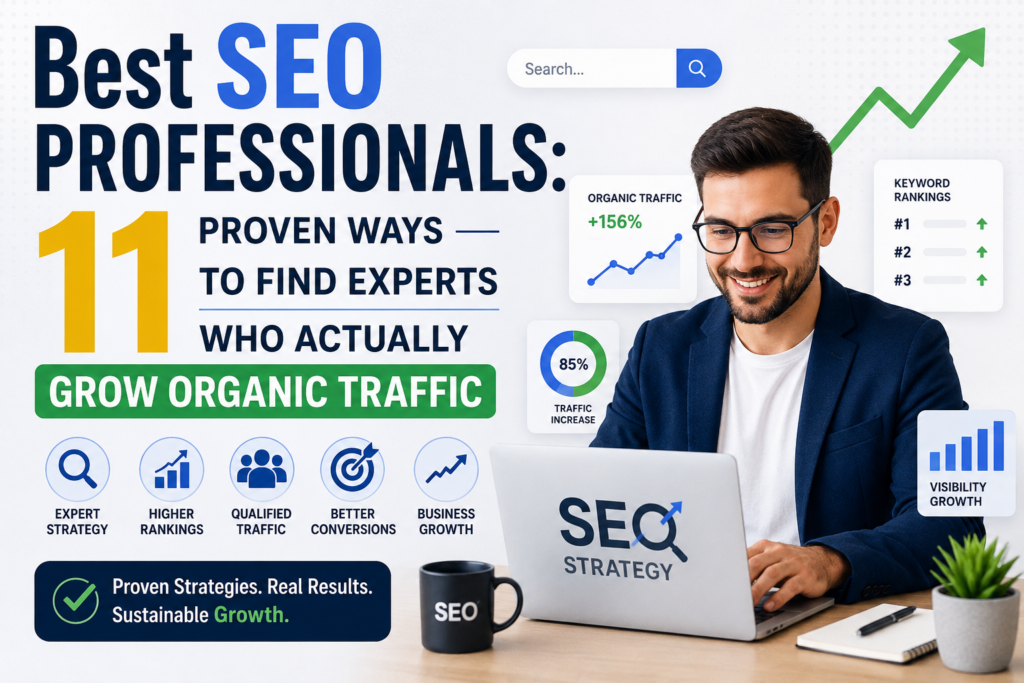
Finding the best seo professionals can make the difference between a website that quietly sits on page five and one that consistently attracts qualified visitors, leads, and customers. But with thousands of freelancers, consultants, agencies, and SEO specialists claiming to deliver “guaranteed rankings,” choosing the right expert is harder than it looks.
The best SEO professional is not simply someone who knows how to add keywords to a page. A genuine expert understands search intent, technical SEO, content strategy, link building, website architecture, analytics, conversion optimization, and Google’s evolving search systems. More importantly, they know how to connect SEO activity with measurable business outcomes.
Google itself describes SEO as helping search engines understand website content while helping users discover a site and decide whether to visit it.
This guide explains what separates the best seo professionals from average providers, what services they should offer, how to evaluate their experience, what questions to ask before hiring them, and how to avoid expensive SEO mistakes.
What Makes the Best SEO Professionals Different?
The best seo professionals combine technical knowledge with business understanding. They do not treat SEO as a collection of isolated tricks. Instead, they look at how a website, its content, its authority, its technical structure, and its audience work together.
A strong SEO professional begins by understanding the business. They want to know who the customers are, what products or services generate revenue, which locations matter, what competitors are doing, and which search queries have commercial value.
This distinction is important because more organic traffic does not automatically mean more revenue. A website can receive thousands of visitors from irrelevant searches and still produce very few leads.
Experienced SEO specialists therefore focus on qualified organic traffic, relevant rankings, conversions, and long-term visibility rather than vanity metrics alone.
Google’s documentation also emphasizes that ranking systems evaluate many signals and systems to determine which pages are relevant and useful for particular queries.
11 Qualities of the Best SEO Professionals
1. They Understand Search Intent
One of the strongest characteristics of the best seo professionals is their ability to understand why someone searches for a particular phrase.
Consider the keyword “best running shoes.” The searcher may be comparing products and preparing to buy.
Now consider “how to clean running shoes.” That person is looking for educational information rather than an immediate purchase.
An experienced SEO consultant recognizes the difference and creates or optimizes pages accordingly.
Search intent generally falls into categories such as informational, navigational, commercial investigation, and transactional intent. Strong SEO strategies map keywords to the correct content type instead of forcing every keyword onto a sales page.
This approach also improves user experience because visitors receive information that actually matches what they expected to find.
2. They Have Strong Technical SEO Knowledge
Technical SEO is another major area separating experienced professionals from beginners.
The best seo professionals understand how search engines discover, crawl, render, index, and evaluate web pages. Google explains that Search operates through three broad stages: crawling, indexing, and serving search results.
A technically capable SEO specialist should be comfortable auditing issues involving:
- Crawlability and indexation
- Robots.txt
- XML sitemaps
- Canonical URLs
- Redirects
- Duplicate content
- Internal linking
- JavaScript rendering
- Structured data
- Mobile usability
- Site architecture
- Core Web Vitals and page experience
- HTTP status codes
- Page speed
- HTTPS
- International SEO
They do not necessarily need to be professional developers, but they should understand how technical problems can affect organic visibility.
For example, publishing 100 excellent articles will not solve a situation where important pages are accidentally blocked from crawling or indexing.
3. They Know How to Build Topical Authority
Modern SEO is much broader than inserting an exact keyword a certain number of times.
The best seo professionals develop topical authority by creating comprehensive coverage around important subjects.
Suppose a company sells accounting software. A weak content strategy might publish one article targeting “accounting software.”
A stronger strategy could cover:
- Accounting software for small businesses
- Bookkeeping automation
- Invoicing software
- Tax reporting
- Accounts payable
- Accounts receivable
- Payroll integration
- Financial reporting
- Accounting software comparisons
- Industry-specific accounting solutions
These related topics create a meaningful content ecosystem.
Google’s SEO guidance recommends creating content that is useful, unique, readable, reliable, and written with the audience in mind rather than simply producing pages for search engines.
4. They Use Data Instead of Guesswork
The best seo professionals make decisions using evidence.
They analyze tools such as Google Search Console, Google Analytics, keyword research platforms, backlink databases, crawling tools, and competitive research software.
Instead of saying, “Your rankings dropped because Google changed something,” an experienced professional investigates.
They may examine:
- Which URLs lost traffic
- Which queries declined
- Whether impressions changed
- Whether click-through rates changed
- Whether competitors gained visibility
- Whether technical problems appeared
- Whether content became outdated
- Whether search intent changed
- Whether a Google ranking system changed
Google Search Console is specifically designed to help website owners and SEO professionals understand search performance and identify issues.
5. They Understand Content Quality
Content is still one of the foundations of successful SEO, but quality means much more than hitting a specific word count.
The best seo professionals know that content should solve a problem better than competing pages.
High-quality SEO content should demonstrate:
Relevance: It directly addresses the searcher’s question.
Depth: It provides enough information to satisfy the intent.
Originality: It contributes something useful rather than simply rewriting competitors.
Accuracy: Claims are supported by reliable information.
Experience: Where appropriate, it includes first-hand insights, examples, observations, or practical knowledge.
Clarity: Readers can quickly understand and navigate it.
Google explicitly states that there is no preferred word count that automatically produces better rankings.
That means a 1,500-word article can outperform a 4,000-word article when it answers the query more effectively.
6. They Know Ethical Link Building
Backlinks remain an important part of SEO, but link building has changed dramatically.
The best seo professionals do not promise to create thousands of backlinks overnight.
Instead, they focus on earning relevant, credible links through strategies such as digital PR, expert contributions, original research, useful resources, partnerships, editorial outreach, and genuinely valuable content.
The academic foundation of modern search also demonstrates why links matter. Brin and Page’s influential 1998 paper on Google’s search engine described how the structure of hyperlinks could help produce more useful search results.
However, quantity should never become the primary objective.
Google’s spam policies specifically warn against tactics designed primarily to manipulate rankings, including abusive scaled content and other manipulative practices.
7. They Measure Business Results
An SEO professional should be able to explain how their work contributes to business growth.
The best seo professionals track metrics beyond rankings.
Important measurements may include:
- Organic conversions
- Qualified leads
- Revenue from organic search
- Organic traffic
- Non-branded impressions
- Click-through rate
- Keyword visibility
- Landing-page performance
- Conversion rate
- Customer acquisition cost
- Return on investment
For an e-commerce company, revenue and transactions may matter most.
For a B2B company, qualified leads and pipeline contribution may be more meaningful.
For a local business, phone calls, direction requests, bookings, and local visibility could be the priority.
The right SEO metrics depend on the business model.
How to Find the Best SEO Professionals
Finding the best seo professionals starts with defining what you actually need.
You may need a technical SEO consultant if your website has indexing, migration, JavaScript, or architecture problems.
You may need an enterprise SEO specialist if you manage tens of thousands or millions of URLs.
You may need a local SEO expert if your business depends on customers in specific cities.
You may need a content-focused SEO strategist if your primary challenge is topical authority and organic visibility.
You may need a full-service SEO agency if your project requires technical optimization, content production, digital PR, link acquisition, and analytics.
Review Their Track Record
Ask candidates for examples of previous work.
Good case studies should explain:
The problem: What was wrong with the website?
The strategy: What did the SEO professional change?
The implementation: What actions were actually taken?
The timeframe: How long did the project take?
The outcome: What measurable improvements occurred?
Be cautious with case studies that only show screenshots of keyword rankings without explaining traffic quality or business results.
A ranking improvement for an irrelevant keyword may look impressive but provide little commercial value.
Look for Industry Experience
The best seo professionals do not necessarily need to have worked in your exact industry, but relevant experience can shorten the learning curve.
A local dentist, SaaS company, law firm, online retailer, and national publisher all require different SEO approaches.
Industry experience can help an SEO specialist understand terminology, competition, customer behavior, regulations, content requirements, and conversion paths.
However, do not automatically reject a talented professional because they have never worked in your niche. Strategic ability and analytical thinking often transfer between industries.
Ask How They Approach an SEO Audit
A serious professional should be able to explain their auditing process.
A comprehensive audit might evaluate:
Technical SEO: Crawlability, indexation, redirects, speed, mobile usability, structured data, and architecture.
On-page SEO: Titles, headings, content quality, internal links, images, search intent, and topical relevance.
Off-page SEO: Backlinks, brand mentions, digital PR, and authority.
Competitive SEO: Competitor content, keyword gaps, link profiles, SERP features, and content opportunities.
Analytics: Traffic trends, conversions, landing pages, and performance changes.
If someone promises to give you a complete SEO strategy after looking at your homepage for five minutes, be skeptical.
Questions to Ask Before Hiring an SEO Expert
Before choosing among the best seo professionals, ask direct questions.
“What would you do during the first 90 days?”
A credible answer should include discovery, auditing, prioritization, implementation, measurement, and iteration.
“How do you measure success?”
Look for business-focused metrics rather than rankings alone.
“How do you approach link building?”
You should hear about relevance, quality, editorial value, relationships, digital PR, or content—not promises of thousands of cheap links.
“How do you handle Google algorithm updates?”
A strong professional should explain that SEO is an ongoing process and that changes should be evaluated using evidence.
“Who will actually work on my account?”
This matters when hiring an agency. The salesperson who presents the strategy may not be the person executing it.
“Can you explain your recommendations in plain English?”
SEO can become extremely technical. Your provider should be able to communicate complicated issues clearly.
Expert Insight: What Google Says About SEO
A useful expert perspective comes directly from Google’s own documentation:
“SEO is about helping search engines understand your content.”
This concise definition from Google Search Central captures an important principle: SEO is not simply about manipulating rankings. It involves making a website easier for search engines to understand while making its information useful for people.
Google’s E-E-A-T framework also adds Experience to expertise, authoritativeness, and trustworthiness. Google explains that first-hand experience can be especially valuable when assessing certain types of content.
That is why the best seo professionals increasingly think beyond traditional keyword optimization.
They consider whether a website demonstrates genuine knowledge, credibility, experience, and trust.
Mini Case Study: A Local Business
Imagine a small HVAC company operating in three U.S. cities.
Its old SEO strategy focused on publishing generic blog posts such as “What Is an Air Conditioner?” These articles generated some impressions but very few customers.
An experienced SEO professional would take a different approach.
They could create dedicated service pages for AC repair, furnace installation, emergency HVAC service, duct cleaning, and maintenance.
Then they could build location-specific pages where appropriate, improve internal linking, strengthen local business information, improve conversion elements, and develop helpful content around real customer questions.
The objective would not simply be to rank for “HVAC.”
The objective would be to increase qualified local search visibility and customer inquiries.
This illustrates why hiring the right SEO professional is about strategy, not merely keyword placement.
Mini Case Study: An E-Commerce Website
Consider an online retailer with thousands of products.
The company discovers that many product pages are poorly indexed, category pages have thin content, filters create duplicate URLs, and internal links are inconsistent.
Publishing more blog posts would not be the first priority.
The best seo professionals would likely address the technical architecture first.
They might improve category structures, canonicalization, internal linking, crawl efficiency, product schema, templates, and category content.
Only after strengthening the foundation would they scale the content strategy.
This is an important lesson: SEO priorities should be based on impact, not trends.
SEO Professionals and AI Search
The role of SEO professionals is also changing as search becomes increasingly influenced by artificial intelligence.
Modern search experiences can provide summaries, conversational answers, related questions, product information, videos, maps, images, and other search features.
This makes visibility more complex than simply reaching position one in a traditional blue-link result.
The best seo professionals therefore need to understand structured content, entity relationships, authoritative sources, brand visibility, user intent, and how information is presented across modern search experiences.
However, AI does not eliminate fundamental SEO principles.
Search engines still need to discover, interpret, organize, and evaluate information.
That makes strong technical foundations, useful content, trustworthy information, and clear website architecture important.
At the same time, businesses should avoid mass-producing low-value AI content simply because automation makes publishing easier.
Google’s current spam documentation specifically warns about scaled content abuse when large volumes of unoriginal pages are produced primarily to manipulate search rankings.
Common Red Flags to Avoid
Not every person advertising SEO services deserves your trust.
Be careful when someone promises guaranteed number-one rankings.
No legitimate SEO professional can control Google’s ranking systems or guarantee a specific organic position.
Google itself states that it does not guarantee that a page will be crawled, indexed, or served in search results.
Another red flag is extreme secrecy.
You do not need every technical detail, but your SEO provider should be willing to explain the strategy, priorities, deliverables, and reporting process.
Be cautious about cheap packages promising hundreds of backlinks every month.
Also question providers who focus entirely on keyword rankings while ignoring conversions, technical health, content quality, and customer experience.
Finally, avoid anyone who suggests manipulating search engines through spammy or deceptive tactics.
Short-term gains can create long-term problems.
How Much Do the Best SEO Professionals Cost?
Pricing varies widely depending on experience, specialization, location, project complexity, and the scope of work.
A freelancer may charge hourly or through monthly retainers.
An SEO consultant may offer a fixed-price audit, strategy project, or ongoing advisory service.
An agency may charge a monthly retainer covering strategy, technical work, content, link acquisition, reporting, and project management.
Enterprise SEO programs can cost substantially more because they involve complex websites, multiple stakeholders, international markets, large content libraries, and extensive technical infrastructure.
Instead of asking only, “How much does SEO cost?” ask:
“What business problem is this investment solving?”
A $2,000 SEO project that produces meaningful leads may be more valuable than a $10,000 project that produces impressive but irrelevant traffic.
The best seo professionals should help you understand expected priorities, risks, timelines, and measurement rather than simply selling a package.
A Practical SEO Hiring Checklist
Before signing a contract, make sure the professional can demonstrate:
Relevant experience with websites or businesses similar to yours.
Technical SEO competence covering crawling, indexing, architecture, and performance.
Content strategy skills based on search intent and topical relevance.
Ethical link acquisition rather than manipulative backlink schemes.
Analytics expertise using reliable performance data.
Clear communication so you understand what is happening.
Transparent reporting that connects SEO activity to meaningful outcomes.
Realistic expectations rather than guaranteed rankings.
E-E-A-T awareness and an emphasis on experience, expertise, authority, and trust.
Long-term thinking rather than shortcuts designed to produce temporary gains.
The more of these qualities a candidate demonstrates, the more confidence you can have in the relationship.
Frequently Asked Questions
Who are the best SEO professionals?
The best seo professionals are experienced specialists who combine technical SEO, content strategy, search intent, analytics, authority building, and business knowledge. Rather than promising guaranteed rankings, they focus on sustainable visibility and measurable business outcomes.
How do I choose an SEO professional for my business?
Start by identifying your biggest SEO problem. Then review case studies, ask about their process, verify what services they personally provide, examine reporting practices, and discuss how success will be measured.
What should an SEO professional do first?
The first step is usually research and diagnosis. A professional should understand your business, audience, competitors, current search visibility, technical condition, content, and conversion goals before recommending major changes.
How long does SEO take to work?
SEO timelines vary significantly. A technically problematic website may see improvements after important issues are fixed, while competitive industries may require many months of consistent content, authority development, and optimization. No ethical professional should promise an exact ranking date.
Is hiring an SEO consultant worth it?
It can be, especially when SEO is important to your customer acquisition strategy but your internal team lacks the necessary expertise. The value depends on the consultant’s ability to identify high-impact opportunities and execute or guide effective improvements.
Should I hire an SEO freelancer or agency?
It depends on your needs. A freelancer may be ideal for focused consulting or smaller projects, while an agency can provide broader capabilities across technical SEO, content, digital PR, development, analytics, and ongoing execution.
Final Thoughts
Choosing among the best seo professionals is not about finding the person with the most impressive sales pitch. It is about finding someone who understands your business, your audience, your market, and the technical realities of organic search.
The strongest professionals combine technical SEO, content strategy, search intent, data analysis, authority building, user experience, and business objectives.
They also understand that SEO is not a one-time task. Search systems evolve, competitors publish new content, customer behavior changes, and websites require continuous improvement.
Google’s own guidance consistently emphasizes useful, reliable, people-first content rather than content created primarily to manipulate search rankings.
Academic research also provides useful context for understanding why search engines evaluate relationships, relevance, and authority across the web. The foundational work of Brin and Page demonstrated the importance of hyperlink structure in large-scale search.
Ultimately, the best seo professionals are the ones who can turn these principles into a practical strategy for your specific business.
If you’re evaluating SEO providers, don’t simply ask who can get you more traffic. Ask who can help the right people discover your business, trust your expertise, and take meaningful action. That is the standard worth using when choosing an SEO partner.