Knowing how to handle bad online reviews is one of the most practical skills a business owner can build, because a single one-star post can sit on your Google Business Profile for years and shape every buying decision that follows it. Roughly 94% of consumers say a negative review has convinced them to avoid a business entirely. That number alone explains why so many owners panic the moment a bad review lands in their inbox.
The good news is that panic is optional. Businesses that respond calmly, quickly, and with a clear process tend to come out ahead, even when the original complaint was harsh or unfair. This guide walks through exactly how to handle bad online reviews at every stage, from the first ten minutes after you spot one to the long-term systems that keep your rating strong.
Why Bad Reviews Feel Like a Crisis (and Usually Aren’t)
A bad review triggers a real emotional response. You built the business, you care about the work, and a stranger just told the internet you failed them.
That reaction is normal, but it’s also the reason so many owners respond badly. Learning how to handle bad online reviews starts with separating the emotional sting from the practical decision in front of you.
Most negative reviews are not actually crises. They’re data points. A pattern of similar complaints tells you something real about your operations, while a single outlier review rarely moves the needle on its own.
The First 24 Hours: What to Do the Moment You See a Bad Review
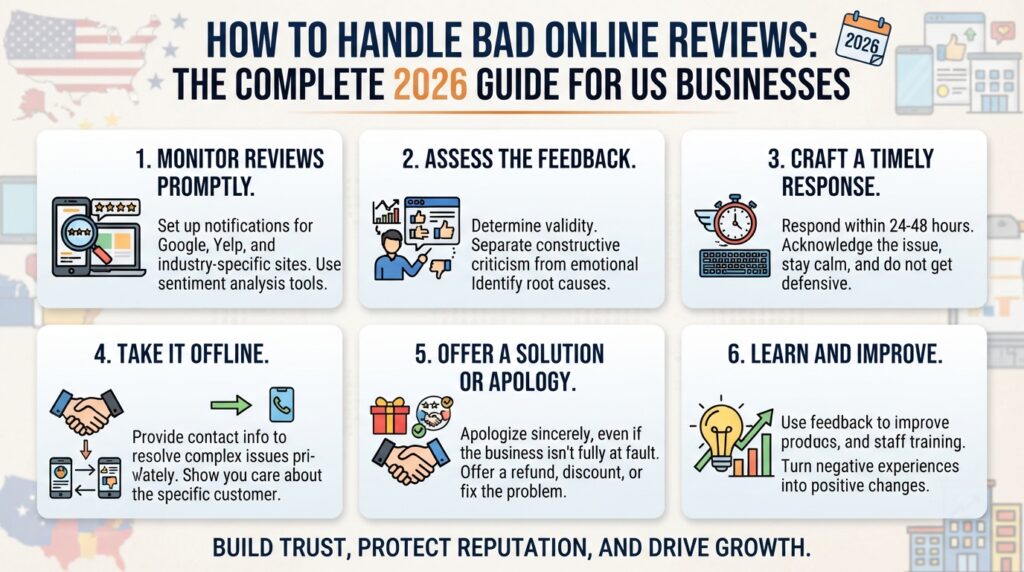
Speed matters, but so does composure. Here’s the order of operations we recommend to every client learning how to handle bad online reviews for the first time.
Step 1: Don’t respond immediately. Read it twice, wait an hour if you’re upset, and confirm the facts internally before you say anything public.
Step 2: Pull up the transaction or service record. Check dates, staff involved, and any prior communication with this customer so your response is accurate.
Step 3: Decide who responds. Owners, managers, or a designated reputation contact should handle this, never a frustrated frontline employee.
Step 4: Draft, don’t publish. Write the response in a notes app first. This single habit prevents most of the worst public review disasters.
Step 5: Publish within 24 to 48 hours. Research from ReviewTrackers found most customers expect responses to reviews within one week, and faster responses correlate with a better business reputation, so a same-day or next-day reply signals you’re actively engaged. US Chamber of Commerce
How to Handle Bad Online Reviews on Google, Yelp, and Facebook
Every platform has its own rules, and treating them all the same is a common mistake.
Google Business Profile. Google allows owner responses directly under the review and gives customers the option to edit or remove their own review at any time. Google will only remove a review itself if it violates specific content policies, such as hate speech, spam, or conflicts of interest.
Yelp. Yelp uses an automated recommendation algorithm that can filter reviews it considers unreliable, and business owners cannot request removal simply because a review is negative. Owners can publicly comment and can privately message the reviewer through Yelp’s messaging tool.
Facebook. Facebook reviews (now called recommendations) can be reported if they violate community standards, but a simple negative opinion almost never qualifies. Responding publicly and inviting a private message is usually the fastest path to resolution.
Nextdoor and niche platforms. Neighborhood and industry-specific review sites tend to have smaller audiences but higher local trust, so a fast, personal response carries extra weight there.
Knowing which platform you’re on changes your strategy before you type a single word.
Writing a Response That Actually Works: A Template Breakdown
A strong response follows a simple structure: acknowledge, clarify or apologize, resolve, and invite offline contact.
Start by thanking the reviewer for the feedback, even when the review feels unfair. This isn’t about agreeing with every claim, it’s about modeling professionalism for every future reader.
Next, briefly address the specific issue raised. Vague replies like “we’re sorry you feel this way” read as dismissive, while specific replies show you actually read the complaint.
Here’s a simple template you can adapt:
“Hi [Name], thank you for taking the time to share this. We’re sorry your experience with [specific issue] didn’t meet the standard we aim for. We’d like to make this right. Please reach out to us directly at [email/phone] so we can resolve this quickly.”
Keep responses under 150 words. Long, defensive replies rarely help and often make the business look worse to neutral readers scanning the thread.
When a Review Crosses the Line: Fake, Defamatory, or Policy-Violating Content
Not every bad review deserves a diplomatic response, because some aren’t legitimate at all.
If a review contains false statements of fact rather than opinion, and those statements damage your business, you may have grounds for a defamation claim. As one legal resource notes, business owners should contact an attorney if the review contains statements that are provably false and damaging to the business’s reputation, since laws exist to protect owners from harmful false claims. This is a narrow legal category, so save it for genuinely fabricated claims, not just harsh opinions. Fourscorelaw
For fake reviews from competitors, bots, or people who were never actual customers, report the review directly through the platform’s flagging tool. Google, Yelp, and Facebook all have reporting mechanisms specifically for reviews that violate content policies.
Document everything. Screenshot the review, note the date, and keep records of your platform report in case you need to escalate further.
Taking the Conversation Offline the Right Way
Public back-and-forth arguments almost never help. The goal of your public reply is to show future customers you’re responsive, then move the real conversation to email or phone.
Include a direct contact method in your public response so the reviewer doesn’t have to hunt for it. A dedicated reputation email inbox works well for this.
When you do connect privately, listen first. Many reviewers just want to feel heard, and a genuine apology combined with a concrete fix often leads them to update or remove the original review voluntarily.
Turning a Bad Review Into a Business Improvement
Every negative review is free market research if you treat it that way.
Track recurring themes across your reviews each month. If three different customers mention slow checkout in the same 30-day window, that’s not bad luck, that’s an operational signal worth fixing.
Share relevant reviews with the team members involved, framed as coaching rather than punishment. Staff who understand how their work shows up publicly tend to take more ownership of the customer experience.
Close the loop internally too. If a review led to a real fix, mention that improvement in future responses to similar complaints, since it shows a pattern of listening rather than a one-off apology.
Building a System So You’re Never Caught Off Guard
Reactive review management burns time and energy. A proactive system fixes that.
Set up Google Business Profile alerts and platform notifications so new reviews reach you or your team within minutes, not days. Many businesses also use dedicated reputation management software to centralize reviews from multiple platforms into one dashboard.
Assign clear ownership. Someone on your team, whether that’s you, a manager, or an agency partner, should be explicitly responsible for monitoring and responding to reviews every week.
Build a simple internal playbook covering how to handle bad online reviews for common scenarios: billing disputes, service delays, product defects, and staff complaints. Having pre-approved response frameworks removes the guesswork during a stressful moment.
Preventing Bad Reviews Before They Happen
The businesses with the strongest ratings aren’t the ones with zero complaints, they’re the ones with a steady stream of positive reviews diluting the occasional bad one.
Ask happy customers directly for reviews at the moment satisfaction is highest, right after a great interaction or successful delivery. A short link in a receipt, follow-up text, or email makes this easy.
Avoid review gating, the practice of only asking customers with positive experiences to leave reviews while filtering out unhappy ones before they reach the platform. Google and the FTC both treat this as a deceptive practice, and it can get your business account penalized.
Train your team on service consistency, since most negative reviews trace back to a repeatable operational gap rather than a random bad day.
Turn Your Review Strategy Into Real Growth With Aura Core Digital
Handling reviews well is only half the picture. The businesses that grow fastest pair strong reputation management with a coordinated SEO and social media strategy that puts their best work in front of new customers every day.
Aura Core Digital helps US businesses build exactly that system, from review monitoring and response frameworks to full digital marketing campaigns that turn a strong reputation into consistent leads.
If you want a team handling your reviews, content, and SEO together instead of juggling three different vendors, visit auracoredigital.com to request a free consultation and see what a coordinated strategy looks like for your business.
Key Takeaways
- Wait before responding publicly, and never let a frustrated employee handle a review alone
- Respond within 24 to 48 hours since faster replies correlate with better ratings
- Match your strategy to the platform, since Google, Yelp, and Facebook each handle removals differently
- Use a short, specific response template: acknowledge, clarify, resolve, invite offline contact
- Report fake or policy-violating reviews directly through the platform, and consult an attorney only for provably false, damaging claims
- Track recurring complaint themes monthly to catch real operational problems
- Build a proactive system with alerts, clear ownership, and a response playbook
- Ask happy customers for reviews consistently instead of relying on damage control alone
Frequently Asked Questions
Can I get a bad review removed from Google?
Google will only remove a review if it violates specific content policies, such as spam, hate speech, or conflicts of interest. A negative but honest review almost never qualifies for removal, so responding professionally is usually the better strategy.
How fast should I respond to a negative review?
Aim to respond within 24 to 48 hours. Research shows most customers expect a reply within a week, and businesses that respond faster tend to see stronger overall ratings over time.