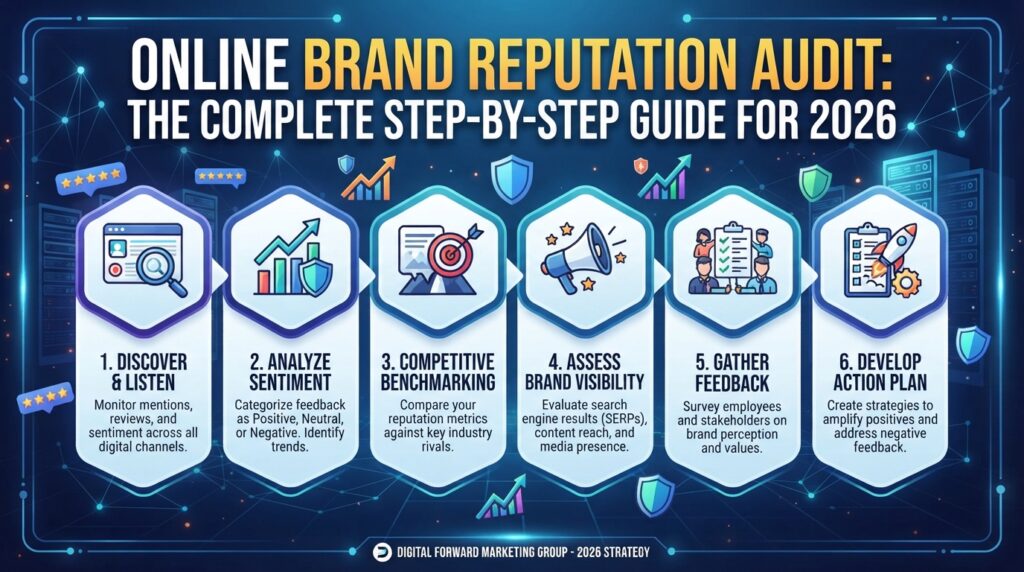
What an Online Brand Reputation Audit Covers and What It Skips
Most published guides stop at data collection. They tell you to search your name, read your reviews, and set up alerts. They rarely explain how to grade what you find or which problem to fix first.
An online brand reputation audit should review four layers:
- Owned assets: your website, social profiles, business listings, and app store pages
- Search results: what Google shows for your brand name, your founders, and your products
- Third-party voice: reviews, forum threads, press mentions, and social conversation
- Machine answers: what AI assistants, AI Overviews, and review summaries say about you
The audit does not fix anything by itself. It produces a baseline, a score, and a ranked list of problems. Repair work comes afterward, and it moves faster when the audit is documented properly.
It is also not a one-time event. Reputation shifts every week as reviews arrive, articles get published, and AI answers change. Treat your first audit as version one of a living document.
Watch for three common mistakes. The first is letting the person closest to the brand run it alone, because familiarity hides problems. The second is searching while logged into your own accounts, which bends the results. The third is ignoring employer review sites, even though candidates and partners read them.
Ideally, one person collects the data and a second person, ideally from outside the marketing team, reviews the findings. Fresh eyes catch what daily exposure makes invisible.
Set Up Your Audit: Name List, Baseline Sheet, and Clean Browser Rules
Before you search anything, decide what you are searching for. Skipping this step is why many audits end up too narrow.
Build a name list that includes:
- Your brand name and legal company name
- Founders and executives who represent the brand publicly
- Product, service, and campaign names
- Old names, abbreviations, and common misspellings
- Local-language or transliterated spellings that customers actually type
Next, create a baseline sheet. A simple spreadsheet works. Use one row per finding, with columns for channel, URL, date checked, rating or sentiment, issue, severity, and owner.
Score severity from 1 (cosmetic) to 5 (actively costing sales). A sample row might read: Google, brand plus “complaints,” position three, a 2024 forum thread about late delivery, severity 4, owner: customer support lead.
Then set your browser rules. Search in a private window while logged out, so personal history does not bias results. Record the date, location setting, and device, and take screenshots, because search results change and you will want proof of your starting point.
Brandwatch’s reputation guide describes the simplest audit as a manual search of your company name, and points to listening platforms that collect mentions from social media, blogs, news, and forums at scale. Its online reputation management guide is a useful companion read. Brandwatch
A small brand can run an online brand reputation audit entirely by hand in two or three days. Larger brands, or brands with several locations, will need listening software to keep up.
Audit Owned Assets: Website, Profiles, and Listings
Start with what you control. It is the fastest place to win points, and it sets the tone for everything else you find.
Website. Check mobile load speed, clear contact details, an about page that names real people, current pricing, and working forms. Broken pages and outdated claims quietly damage trust. If your site needs technical fixes, a web development partner can clear them faster than a patchwork of plugins.
Trust signals. Look for testimonials with real names, visible policies for returns or refunds, and clear ownership details. Visitors who cannot tell who runs a business assume the worst.
Business listings. Confirm that your name, address, and phone number match across Google Business Profile, directories, and maps. Reviewshake’s audit checklist treats consistent business name, address, and phone details across directories as a core check. Inconsistency confuses customers and search engines alike. Reviewshake
Social profiles. Confirm that bios, links, logos, and pinned posts are current. Check the date of your last post and your average reply time to messages. An account silent for six months tells visitors nobody is home.
Forgotten profiles. Search for old accounts, abandoned marketplace shops, and expired campaign pages. These often rank for your brand name and show outdated information that contradicts your current offer.
Audit Branded Google Results Like a Buyer Would
Run these searches in a private window and record what appears on page one:
- [brand name]
- [brand name] reviews
- [brand name] complaints
- [brand name] scam or legit
- [brand name] pricing
- [brand name] vs [top competitor]
- [founder name]
For each query, count how many of the ten results you control, such as your website, verified profiles, and listings. A working target is to control or influence at least half of page one for your plain brand name. That figure is a rule of thumb from agency practice, not an industry standard.
Then check the surrounding features. Look at autocomplete suggestions, People Also Ask boxes, image results, video results, news items, and any knowledge panel. Autocomplete is especially revealing because it shows what strangers type after your name.
Record every negative or outdated result with its position, source, and age. A two-year-old forum complaint at position three matters more than a fresh complaint buried on page four.
The “complaints” and “scam” searches deserve extra attention. If they return nothing, that is a good sign. If they return a thread, read every reply, because the top comment often decides how buyers feel.
An online brand reputation audit is more useful when it includes two competitors for comparison. If they hold more of page one than you do, log that gap as a finding, not a footnote.
Audit Reviews, Ratings, and Reply Quality
Reviews are where buyer trust is won or lost, and the bar keeps rising. In BrightLocal’s 2026 data, 31% of consumers will only use businesses rated 4.5 stars or higher, up from 17%, and 74% look for reviews written in the last three months. PinMeTo
List every platform where your brand can be reviewed: Google, Facebook, Trustpilot, marketplaces, app stores, industry directories, and employer review sites. For each one, capture five numbers: average rating, total review count, reviews in the last 90 days, reply rate, and median reply time.
Then read at least 50 reviews and tag them by theme. Delivery, pricing, support, product quality, and staff behavior are common tags. Your top three negative themes are your real reputation risks, whatever your average rating says.
This part of the online brand reputation audit is where most brands find their first surprise. A 4.6 average can hide a steady stream of complaints about one specific issue.
Check reply quality as well. Roughly half of consumers reject copy-paste replies. A strong reply thanks the reviewer, names the specific issue, states what you are doing about it, gives a direct contact, and then stops. PinMeTo
Watch for suspicious patterns too. Clusters of near-identical reviews posted within days, reviews about products you do not sell, and reviewers with no history all deserve a flag. Report them to the platform with evidence, and do not retaliate.
Then do the rating math. To find how many new five-star reviews lift your average to 4.5, use this formula: (4.5 × current count minus current total stars) ÷ 0.5.
For example, a brand with 60 reviews averaging 4.2 holds 252 stars in total. It needs 36 new five-star reviews to reach 4.5, and more if any new ones score lower.
Audit Social Mentions, Forums, and Local-Language Conversation
Tagged posts are the smallest slice of what people say. Untagged mentions, comment threads, group posts, and video comments carry more honest opinion.
Search each platform for your brand name without the @ symbol. Check Reddit, Quora, Facebook groups, YouTube comments, LinkedIn posts, and any forum popular in your industry. Look under competitor posts too, where customers compare options openly.
Do not skip mentions written in other languages or scripts. If customers write about you in a local language or in transliterated spelling, English-only searches will miss them entirely. Use the spelling variants from your name list.
Sample the last 90 days and classify 100 mentions as positive, neutral, or negative. Record the percentages and the topics behind the negative ones. This gives you a sentiment baseline to compare against next quarter.
Set escalation rules while you are here. A complaint from a customer with a large following, or one that mentions safety, money, or legal issues, should reach a decision-maker the same day.
Free alerts help between audits. Cision recommends Google Alerts for brand names, products, services, and key executives, alongside regular checks of review sites. Paid tools go further: Brand24 gathers public mentions from social platforms and review sites into one place. CisionBrand24
Remember the limits. Private messages, closed groups, and forwarded chats cannot be searched. Ask your support and sales teams what customers say there, and add those themes to your baseline.
Audit What AI Assistants Say About Your Brand
This is the layer most competitor guides ignore, and it is growing fast. 82% of consumers read AI-generated review summaries, and 23% would decide on the summary alone. GBPPromote
Ask ChatGPT, Gemini, Perplexity, and Google’s AI results the same set of questions:
- What is [brand]?
- Is [brand] trustworthy?
- What are the best [your service] providers in [your city]?
- [Brand] vs [competitor]: which is better?
- What do customers complain about with [brand]?
For each answer, record whether you are mentioned, whether the facts are correct, which sources are cited, and whether the tone is positive, neutral, or negative. Run each prompt more than once, because answers vary from one run to the next.
Wrong answers usually trace back to a source. An outdated directory listing, a stale press article, or a competitor’s comparison page often feeds the error. Suppose an assistant says you were founded in 2015 when you launched in 2019. Find the page that states 2015, correct it, and then publish the right date clearly on your own site.
Consistency helps machines as much as people. Use the same brand description, service names, and key facts on your website, profiles, and listings, so assistants have one story to repeat.
An online brand reputation audit that skips this layer will look complete and still miss where a growing share of buyers now start.
Score Your Online Brand Reputation Audit With a 100-Point Scorecard
Every online brand reputation audit needs a number attached, or improvement stays a feeling. This working scorecard is a framework for consistency, not an industry standard.
- Branded search results (20 points): full marks when you control most of page one and no harmful result sits in the top five
- Reviews and ratings (25 points): full marks for a 4.5-plus average, steady recent reviews, and fast, personal replies
- Owned assets (15 points): full marks for accurate, consistent, fast, and current profiles and listings
- Social and forum sentiment (15 points): full marks when positive mentions clearly outnumber negative ones and complaints get answers
- AI answers (15 points): full marks when assistants name you, describe you accurately, and cite sources you trust
- Response and governance (10 points): full marks when someone owns reputation, alerts are active, and a crisis contact list exists
Add the category scores together. A total of 85 or above signals a strong reputation that needs maintenance. A score from 65 to 84 means targeted fixes will pay off. Below 65, treat reputation as a business risk and fix it before spending more on ads.
Here is a worked example. A small online retailer scores 12 on search results, 14 on reviews, 11 on owned assets, 8 on social, 5 on AI answers, and 3 on governance. That totals 53, and the AI and governance gaps are the cheapest points to recover.
Save your score and screenshots. Next quarter’s audit only means something if you can compare it against this one.
Turn Findings Into a 30-60-90 Day Fix Plan
Write the fix plan directly from your online brand reputation audit, so every task links back to a scored finding. Rank each finding by three factors: how many people will see it, how believable it is, and how recent it is.
A fresh one-star review on your top listing outranks an old post on an obscure forum. Severity and reach, not volume, decide the order.
Days 1 to 30: fix what you fully control. Correct listing details, update profiles, reply to the review backlog, remove outdated claims from your site, and claim any unclaimed profiles.
Days 31 to 60: build your systems. Ask every satisfied customer for honest feedback after purchase, with no conditions attached. Publish content that can rank for your brand name, such as case studies, an updated about page, and clear service pages. A specialist SEO services team can plan that content so it gradually takes over page one.
Days 61 to 90: work on AI answers and third-party sources. Correct errors at their source, pitch accurate stories to industry publications, and set up monthly reporting.
Keep a crisis routine ready. In the first 24 hours of a serious negative story, confirm the facts, pause scheduled promotional posts, publish one clear statement on owned channels, and reply personally to the top complaints. Brief your support staff so every answer matches.
Handle bad content carefully. Legitimate routes exist: platform reports for fake or abusive reviews, and formal requests for defamatory or private information. Never buy positive reviews, never pay for sentiment-based feedback, and never hide honest negative reviews.
These practices carry legal risk in the US. The FTC’s rule banning fake reviews took effect on October 21, 2024, and prohibits buying, selling, or spreading fake reviews as well as suppressing negative ones. The agency’s announcement of the final rule explains the scope, and one law firm summary puts civil penalties for knowing violators at up to $51,744 per violation. Alston & BirdWilmerHale
Rules differ by country, and platforms ban these tactics regardless, so check local law with a qualified lawyer.
How Often to Repeat the Audit and Which Tools to Use
Run a full audit twice a year, and again after any rebrand, product launch, ownership change, or public complaint that spreads. Between audits, check ratings monthly and read alerts weekly.
A free toolkit covers more than most people expect: private-window searches, Google Alerts, native analytics on each social platform, Google Business Profile insights, and your baseline spreadsheet. That is enough to complete a first online brand reputation audit at zero software cost.
Paid tools make sense later. Listening platforms such as Brand24 or Brandwatch, review management software, and AI visibility trackers pay off when mention volume is too high to read by hand or when you manage several locations.
Assign owners. Reputation work stalls when nobody’s name sits next to it. Choose one person to run the audit, one to reply to reviews, and one executive to approve responses to serious issues.
Finish each round with a one-page report: your score, the top five findings, what changed since last time, and the next three actions. Short reports get read, and read reports get funded.
Key Takeaways
- The audit covers four layers: owned assets, search results, third-party voice, and AI answers.
- Build a name list and baseline sheet before you search, and always use a private window.
- Aim to control or influence at least half of page one for your brand name.
- Track rating, recency, and reply quality together, because buyers judge all three.
- Ask AI assistants the same five prompts every time and record the answers.
- Score every category out of 100 and repeat the scoring each quarter.
- Fix what you control in 30 days, build review and content systems by day 60, and tackle AI and third-party sources by day 90.
- Never buy, fake, or suppress reviews.
Get Your Brand Audited by Aura Core Digital
You can run this process yourself, but it takes focus, tools, and an outside view. Aura Core Digital’s team audits your search results, reviews, social conversation, and AI visibility, then hands you a scored report and a prioritized fix plan.
You get a documented baseline, a 100-point score, a 90-day action plan, and a named owner for every fix.
Request a consultation or visit auracoredigital.com to talk through your brand. Reach out this week, and you will know exactly what buyers see before your next campaign goes live.
Frequently Asked Questions
How long does a first brand reputation audit take?
A first audit usually takes one to three working days for a small brand with a handful of platforms. Later rounds take a few hours because your name list and baseline sheet already exist.
Can I run an audit without paid tools?
Yes, free tools cover the basics. Private-window searches, Google Alerts, native platform analytics, and a spreadsheet are enough for a first pass. Add paid listening software when mention volume becomes too large to read by hand.