- not just a raw data export
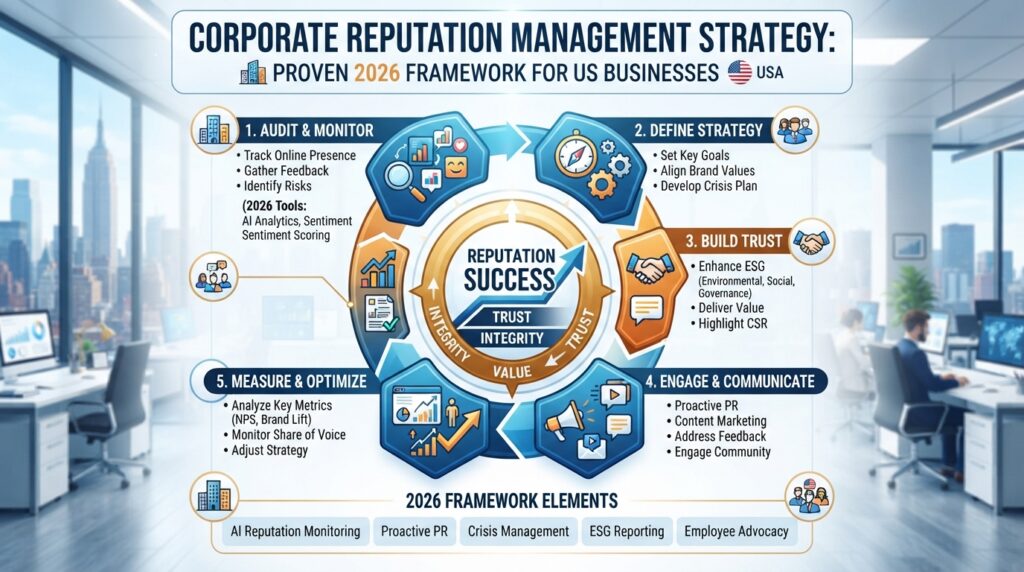
Aura Core Digital builds this monitoring layer directly into client SEO and social listening programs, so search visibility and reputation signals get tracked side by side instead of in separate systems. Treating them separately means SEO teams and communications teams often discover the same emerging problem days apart, and that delay is exactly what limits how much damage control is still possible.
Choosing tools matters less than choosing accountability. A company running a free Google Alerts setup with a disciplined weekly review process will often outperform one running expensive enterprise software that nobody actually checks. The system only works if a real person owns the output and acts on it consistently.
The Crisis Response Framework: What Happens in the First 24 Hours
Even the most complete corporate reputation management strategy needs a documented crisis protocol, because prevention alone cannot stop every incident from happening.
A defensible first-24-hours protocol looks like this:
- Verify before responding. Confirm the facts internally before any public statement goes out, even under pressure to respond fast.
- Centralize the message. One spokesperson, one approved statement, no improvised comments from other employees on personal accounts.
- Respond on the platform where it started. A Reddit thread needs a Reddit-native response, not just a formal press release nobody there will read.
- Document everything. Screenshots, timestamps, and internal decisions matter later for legal review and post-incident analysis.
- Follow up publicly once resolved. Silence after a resolution often reads as indifference to the exact audience that was watching closely.
Speed matters, but accuracy matters more. A statement that has to be retracted damages credibility further than the original incident usually does, and it hands critics a second story to tell.
Consider a common scenario: a viral customer complaint about a billing error spreads across social platforms before the finance team has confirmed what actually happened. Companies without a protocol often let marketing respond immediately with a generic apology, which then contradicts the facts once support confirms them. Companies with a protocol hold the public response until verification completes, communicate a short acknowledgment in the meantime, and follow with a fact-based resolution once the details are confirmed. The second approach takes slightly longer but almost always closes the incident faster overall, because it avoids the second wave of criticism that a contradicted statement invites.
Winning Visibility in AI Overviews and Generative Search
Search behavior has shifted meaningfully. Prospects now see AI-generated summaries from Google AI Overviews, SearchGPT, and Perplexity before they click a single link, and those summaries pull heavily from structured, well-sourced content and recent, credible press mentions.
A modern plan has to feed these systems accurate, current information, because AI summaries are quickly becoming the first reputation touchpoint a buyer or candidate ever sees, well before they land on a company’s own website.
Practical steps that improve generative search visibility include:
- Publishing original data, case studies, and expert commentary that AI systems can cite directly
- Keeping company details such as leadership names, certifications, and service areas consistent across every listing and directory
- Earning mentions on authoritative third-party sites, since AI systems weight citation quality heavily when assembling a summary
- Updating outdated press pages and About sections that still reference former leadership or discontinued services
Agencies that combine SEO and generative search optimization into a single workstream are better positioned to keep a company’s AI-generated summary accurate, rather than leaving it to chance and outdated web copy.
Measuring ROI: Proving the Program Works
Executives approve budgets faster when reputation work ties directly to business outcomes instead of vanity metrics like follower counts or raw mention volume alone.
The strongest ROI models connect reputation signals to measurable business KPIs: pipeline velocity, recruiting funnel quality, customer acquisition cost, and investor-relations meeting tone all move noticeably when reputation shifts in either direction.
A practical measurement stack looks like this:
| Layer | What It Tracks | Business Signal It Connects To |
|---|---|---|
| Leading indicators | Sentiment, review volume, response time | Early warning before revenue impact appears |
| Mid-funnel indicators | Share of voice, search visibility, media pickup | Pipeline quality and lead volume |
| Lagging indicators | Customer acquisition cost, retention, offer-acceptance rate | Confirmed financial and hiring impact |
Reporting all three layers together, rather than isolated vanity metrics, is what turns a reputation program from a cost center into a line item leadership actively defends at budget time.
A useful exercise is running a baseline audit before launching any new initiative. Pull twelve months of review sentiment, search visibility, and candidate acceptance rates, then track the same figures again six months after the program starts. The comparison rarely produces a perfectly clean causal line, since reputation interacts with many other business factors, but consistent upward movement across all three layers is a strong signal the investment is working rather than simply generating activity.
Executive and Leadership Reputation as a Business Asset
Corporate reputation and executive reputation are no longer separate conversations, even though most companies still manage them with separate teams and separate budgets. Candidates research the CEO before applying. Journalists profile founders as closely as the companies they lead. Investors weigh leadership credibility directly into valuation models.
A complete corporate reputation management strategy includes a leadership visibility plan: thought leadership placements, consistent executive bios across every platform, and a clear protocol for how leaders speak publicly during sensitive moments.
Ignoring this layer leaves a company’s most visible asset, its leadership team, entirely unmanaged, which is a gap competitors are increasingly quick to exploit through their own executive positioning.
Executive visibility also compounds over time in ways a single press release never will. A founder who publishes consistent, substantive commentary on industry trends builds a body of citable content that AI search tools and journalists both draw on repeatedly, while a founder with no public presence leaves that narrative entirely to whoever chooses to write about the company first.
Industry-Specific Considerations for US Companies
Reputation risk looks different depending on the sector, and a generic plan applied uniformly across industries tends to underperform.
- Healthcare and finance: heavy regulatory oversight means every public statement needs legal review before it goes out, and a single compliance misstep can trigger scrutiny from multiple agencies at once
- Retail and eCommerce: review velocity and return experience dominate public perception more than press coverage does, since most buyers check star ratings before they check the news
- B2B and professional services: LinkedIn presence, case studies, and analyst relationships carry more weight than consumer review sites, because the buying committee researches credibility long before a sales call happens
- Manufacturing and industrial: supply chain transparency and safety records increasingly shape public trust, particularly as procurement teams add ESG criteria to vendor selection
Tailoring channel priority and response tone to the specific sector produces measurably better outcomes than applying one template across every client or business unit. A healthcare provider ignoring Glassdoor in favor of patient reviews alone, for example, will miss the staffing complaints that often predict a public trust problem months before it reaches patients directly.
Common Mistakes That Undermine Reputation Programs
Reputation programs rarely fail because a company lacks budget. They fail because the budget gets spent on the wrong layer of the problem while the fundamentals stay unmanaged. Even well-funded programs fail for predictable, avoidable reasons:
- Treating reputation as a marketing task instead of a cross-functional business function with shared ownership
- Responding to negative reviews with generic, copy-paste replies that read as insincere to anyone reading them
- Monitoring only customer-facing channels while ignoring employee and investor sentiment entirely
- Waiting for a crisis to build a response protocol instead of preparing one well in advance
- Failing to update AI-facing content, so outdated information keeps surfacing in generated search summaries
Avoiding these mistakes matters as much as any single tactic listed above, since one unmanaged gap can undo months of otherwise consistent work. The companies that manage this well tend to treat it the same way they treat financial reporting: a scheduled, owned, recurring discipline rather than a project that gets attention only when something goes wrong.
Build Your Reputation Strategy with Aura Core Digital
A corporate reputation management strategy works best when it connects directly to the SEO, content, and digital visibility work that shapes how AI search engines and human prospects see a company. Aura Core Digital builds integrated SEO, reputation management, and digital growth programs for US businesses that need their online presence and their public reputation working in the same direction.
If your company needs a monitoring system, a crisis-ready response plan, or a search presence that actually reflects your reputation accurately, explore our SEO and reputation services or request a free consultation to build a plan tailored to your industry and risk profile.
Key Takeaways
- A corporate reputation management strategy has to cover five stakeholder groups, not just customers.
- Real-time monitoring catches sentiment shifts weeks before they become public crises.
- A documented first-24-hours crisis protocol limits damage far more than improvised responses do.
- AI Overviews and generative search are now a primary reputation touchpoint, not a side channel.
- ROI reporting should connect leading, mid-funnel, and lagging indicators, not vanity metrics alone.
- Executive reputation is part of corporate reputation and needs its own dedicated visibility plan.
- The most common failure is treating reputation work as reactive instead of a standing business function.
Frequently Asked Questions
What is the first step in building a corporate reputation management strategy?
Stakeholder mapping comes first. Identify the five groups shaping a company’s reputation, customers, employees, investors, regulators, and media, and assign monitoring ownership for each before choosing any tools.
How much should a mid-size US company budget for reputation management?
Cost varies by scope and industry risk, but most mid-size companies invest in a monitoring platform plus either an internal owner or an agency retainer. The bigger cost is usually delay, since unmanaged reputation damage takes far longer and far more budget to reverse than early monitoring ever would.